

iMD Corporate News | September 2024 | Government & Law Enforcement
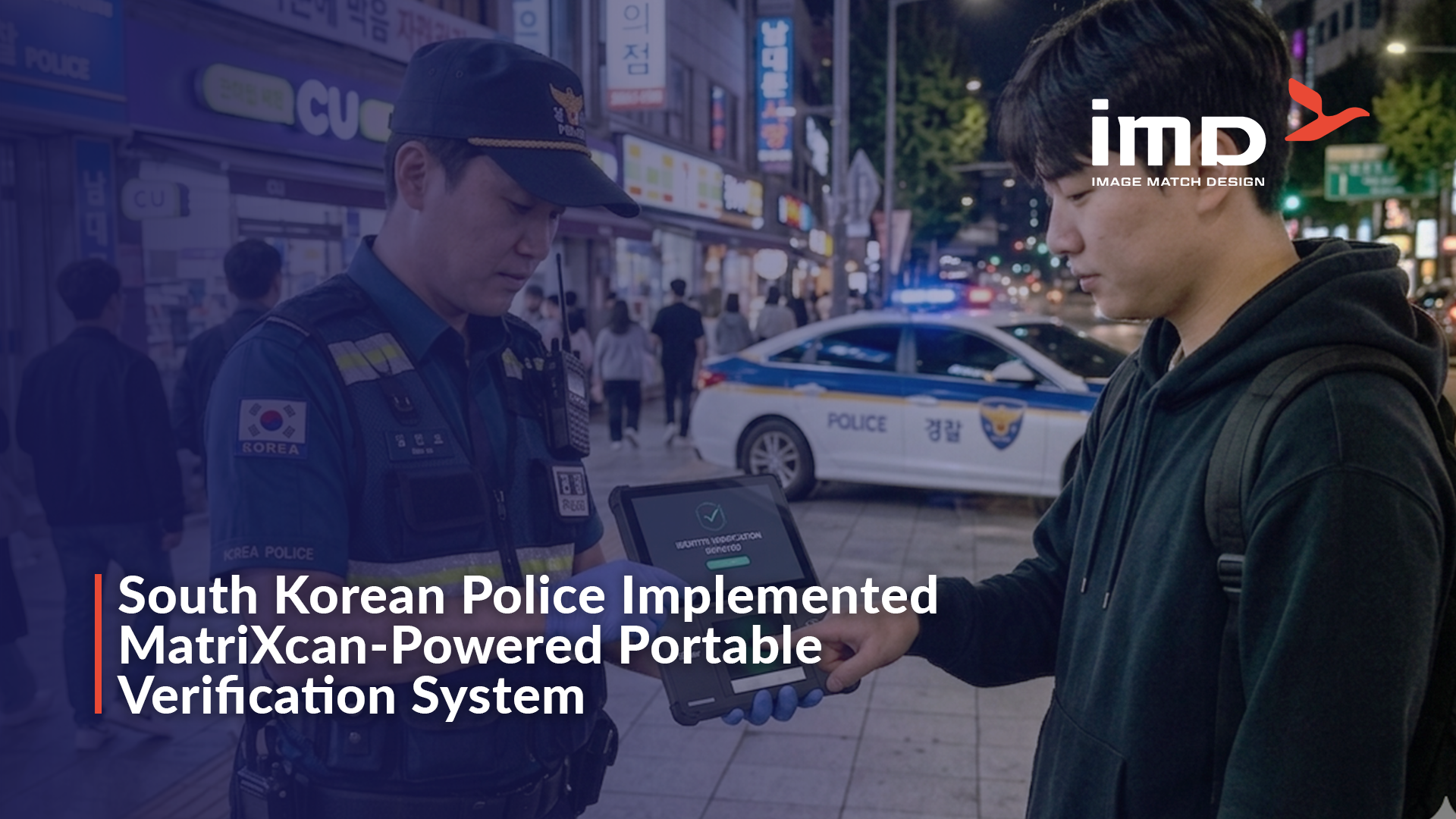
South Korean Police Deploy MatriXcan™-Powered Portable Fingerprint Verification System
Seoul, South Korea – February 18, 2024 – South Korea's National Police Agency has announced the nationwide deployment of a groundbreaking portable identification system powered by iMD's MatriXcan™ fingerprint biometric technology. Designed to rapidly identify vulnerable individuals — including those suffering from dementia or intoxication — the system marks a pivotal advancement in field-based identity verification for law enforcement.
By compressing verification time from 30 minutes to just 5 minutes, MatriXcan™ delivers a measurable, life-saving impact on how police respond to missing persons cases across South Korea.
Agency
Republic of Korea National Police Agency (경찰청)
Technology
MatriXcan™ fingerprint biometric sensing by iMD
Announced
February 18, 2024 · Seoul, South Korea
Use Case
Field identification of dementia patients, intoxicated & missing individuals
Time Saving
30 minutes → 5 minutes (83% reduction)
A Critical Challenge: Identifying Vulnerable Individuals in the Field
South Korean law enforcement faces a significant operational burden when responding to cases involving vulnerable individuals. According to police data compiled as of June 2023, officers handled 8,440 reported cases of missing individuals with intellectual disabilities, autism, or developmental disorders, 14,667 cases involving persons with dementia, and a staggering 396,282 cases of missing intoxicated individuals in a single year.
In many of these situations, every minute of delay carries life-threatening consequences. Individuals with dementia frequently have complicating health conditions, while intoxicated persons may be exposed to environmental hazards. The traditional 30-minute manual identification process was simply not fit for modern field conditions — a gap that MatriXcan™ was built to fill.
Why MatriXcan™: Performance Built for Real-World Conditions
iMD's MatriXcan™ technology was specifically engineered to maintain high biometric acquisition quality across diverse populations and challenging environmental conditions. Its ability to reliably capture usable fingerprint data from elderly individuals, those with worn ridges, or persons in varying states of distress made it the clear choice for this deployment.
Cross-Population Accuracy
MatriXcan™ maintains consistent accuracy across age groups and skin conditions — including elderly skin, which is frequently encountered in dementia and elder welfare cases. Police officers can capture a reliable biometric signal even under degraded conditions.
5-Minute Field Verification
By reducing the identification process from 30 minutes to 5 minutes, MatriXcan™-powered devices allow officers to act decisively in time-critical situations — reuniting individuals with caregivers or medical personnel far sooner than was previously possible.
Portable, Field-Ready Design
The portable device integrates MatriXcan™ directly into a handheld form factor, enabling patrol officers and first responders to initiate fingerprint-based identification anywhere — on streets, transit, or remote locations — without returning to a station or specialized terminal.
Government-Grade Reliability
MatriXcan™ meets stringent government certification standards, ensuring the data quality and system reliability required for lawful identity verification by a national law enforcement agency.
Scale of the Problem: Missing Persons Data
Source: Republic of Korea National Police Agency, as of June 2023
Public Safety Impact: Beyond Efficiency
The deployment is not simply an administrative upgrade — it represents a direct public safety intervention. When an elderly individual with dementia is found disoriented, or an intoxicated person is unresponsive, the ability to confirm identity in 5 minutes rather than 30 determines whether medical care, family notification, and protective custody happen in time.
This is the operational philosophy behind MatriXcan™: delivering biometric precision where and when it matters most, in the hands of first responders with no margin for error.
Frequently Asked Questions
+ What is the MatriXcan™-powered portable verification system?
It is a handheld fingerprint identification device integrating iMD's MatriXcan™ biometric sensing technology, deployed by South Korea's National Police Agency to rapidly verify the identity of missing or vulnerable individuals in the field — reducing processing time from 30 minutes to 5 minutes.
+ Why is fingerprint biometrics used instead of facial recognition for this application?
Fingerprint verification offers a highly reliable, privacy-conscious method that works even when individuals are unable to cooperate fully. MatriXcan™'s ability to capture high-quality images from elderly, worn, or damaged skin makes it particularly suited to the demographics most commonly encountered in missing persons cases.
+ How does MatriXcan™ technology work in field conditions?
MatriXcan™ uses iMD's proprietary sensing layer to capture detailed fingerprint ridge patterns even under adverse conditions — including dry, wet, aged, or calloused skin. The captured image is then matched against a government database in real time via a secure data connection, returning a verified identity in minutes.
+ What scale of problem does this system address in South Korea?
As of June 2023, South Korean police recorded over 419,000 annual missing persons cases across three vulnerable categories: individuals with intellectual disabilities or autism (8,440), dementia patients (14,667), and intoxicated individuals (396,282). The MatriXcan™ system is designed to accelerate response across all three groups.
+ Is MatriXcan™ available for other government or law enforcement agencies?
Yes. iMD works with government agencies, systems integrators, and biometric solution providers worldwide. MatriXcan™ technology is available for integration into portable devices, desktop scanners, kiosks, and border control infrastructure. Contact iMD to discuss deployment requirements for your agency.
+ What certifications does MatriXcan™ hold for government use?
MatriXcan™ meets FBI Appendix F and FBI PIV certification standards — the gold standard for fingerprint image quality in government and law enforcement applications. These certifications ensure that biometric data captured by MatriXcan™ is admissible and interoperable with national identity databases.
Deploy MatriXcan™ in Your Agency or Integration
iMD partners with law enforcement agencies, government bodies, and technology integrators to deploy field-ready biometric solutions. Contact us to learn how MatriXcan™ can transform identification workflows in your context.
Contact iMD Today →
MatriXcan
fingerprint biometrics
South Korean police
portable verification system
law enforcement biometrics
identity verification
dementia identification
iMD Image Match Design
government fingerprint scanner
FBI Appendix F
missing persons technology