

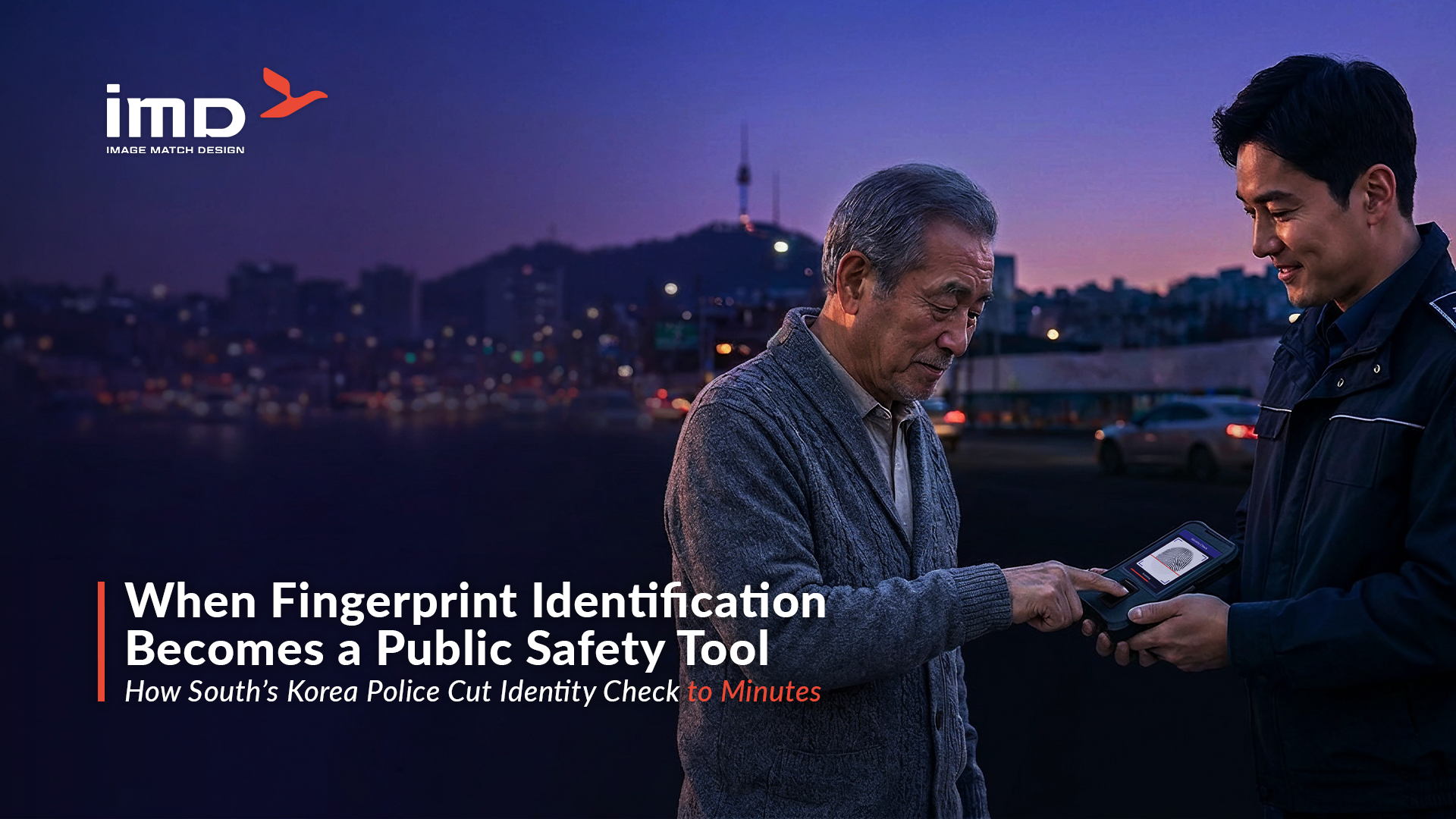
iMD Success Case | Law Enforcement | South Korea, 2024
Fingerprint Identification for Dementia Patients: How South Korea's Police Cut Identity Checks to Minutes
Picture an evening patrol. An officer meets an elderly person walking alone, calm but unsure where they are. They cannot give a name, an address or a phone number, and they carry no identification. Somewhere across town, a family is already searching. The officer wants one thing: to get this person home safely, and the first step is knowing who they are.
For people with dementia, that first step is often the hardest, because memory is exactly what fails. Fingerprint identification of dementia patients works because a fingerprint needs neither memory nor documents. In this case study we look at how South Korea's National Police Agency brought that capability to local police stations and patrol boxes nationwide, and the role iMD's fingerprint modules play in it.
Program at a glance
Program: Mobile Identity Verification System, South Korea National Police Agency. Rollout: nationwide at local police stations and patrol boxes from 19 February 2024. Method: a portable fingerprint scanner connected to the officer's smartphone captures two or more fingers and compares them with police fingerprint data. Time to confirm identity: 30–60 minutes before, 5–6 minutes expected on site. iMD's role: fingerprint module supplier.
A Problem That Starts With a Missing Name
Cases like the one above are common. In the year before the rollout, South Korean police received 14,677 missing-person reports involving people with dementia, along with 8,440 reports for people with intellectual, autism-spectrum or mental disabilities. Many of these people can still walk, talk and appear perfectly well, which is what makes them hard to identify and easy to lose.
Before the new system, confirming who someone was meant taking them to a nearby station with a fixed fingerprint identification terminal. That took 30 minutes to an hour. For an older person who may also live with a condition such as diabetes, and for a family waiting for news, that time counts.
Bringing Identification to the Person
The police agency's answer was simple in principle: stop moving the person to the system, and move the system to the person. Officers already carry 112 duty smartphones. Adding a small portable fingerprint scanner to that phone turns every patrol into a mobile identification point.
1. Capture on the spot
The officer captures two or more of the person's fingers with the portable scanner connected to the smartphone. Fingers can also be photographed with the phone itself.
2. Compare with police fingerprint data
A dedicated app compares the captured prints with the fingerprint data held by the police and returns an identity result.
3. Call the family or arrange care
With the identity confirmed, the officer can contact a guardian or a care provider straight away, without first travelling to a station.
The police expect identification time to fall from up to an hour to five or six minutes, and they have said that field trials confirmed the system's practicality before nationwide launch. Public-sector recognition followed: the system received the Prime Minister's Award at a government best-practice contest in November 2023.
What Makes Field Capture Different
Capturing a fingerprint at a roadside is harder than at a desk. The officer has little control over lighting, weather or how settled the person feels, and the person may not understand what is being asked. Three engineering points stand out.
Worn ridges and dry skin
Older fingers often have shallower ridges and drier or more worn skin, which can produce low-contrast images. A module that gives usable images on those fingers means fewer retries for the officer and less stress for the person. Quality scoring helps here, as we explain in our article on NFIQ 2 fingerprint image quality.
More than one finger
The system asks for two or more fingers. If one print is partial or smudged, the others still give the matcher something to work with. Searching a capture against many stored records is a one-to-many (1:N) identification task, which is a different job from the one-to-one verification used to unlock a phone. Our piece on enrollment vs. verification explains the distinction.
Compact, phone-friendly hardware
A scanner that patrol officers carry every day has to be small, light and rugged, and it has to connect cleanly to a smartphone. That calls for compact modules with simple interfaces and an SDK the device maker can integrate. It is the same set of properties we describe in what makes a fingerprint module government-grade.
Where iMD Fits
iMD supplies the fingerprint modules used in these portable scanners. The police agency owns and runs the program, and the scanner design, the smartphone app and the identification software are the work of other parties. That division of roles is typical of programs like this, and it is where we are most useful: making sure the first image the system sees is a good one.
What It Means for People and Families
For iMD, the most meaningful part of this project is not a specification. It is that our fingerprint modules have helped police identify elderly people with dementia and bring them back to their families. A shorter wait at the roadside means a shorter wait at home. We do not describe individual cases, out of respect for the people and families involved.
Lessons for Other Programs
Take capture to the person
When someone cannot travel or cannot speak for themselves, portable capture removes the longest step in the process.
Test on the fingers you will actually meet
Programs serving older or vulnerable people should test image quality on those fingers, not only on a general population.
Be clear about the data
A fingerprint search is only as useful as the records it searches. Say what data is held, who can search it and how privacy is protected.
Frequently Asked Questions
+ How does fingerprint identification help identify people with dementia?
An officer captures the fingerprints of a person who cannot state their name and compares them against stored fingerprint records. If there is a match, the system returns the person's identity so that family or a care provider can be contacted.
+ What is South Korea's Mobile Identity Verification System?
It is a National Police Agency system operating at local police stations and patrol boxes nationwide since 19 February 2024. It pairs officers' 112 smartphones with a small portable fingerprint scanner and an app that compares captured prints with police fingerprint data.
+ How long does a portable fingerprint identity check take?
Police expect the check to take about 5 to 6 minutes on site, compared with 30 to 60 minutes when the person had to be taken to a station with a fixed system.
+ Why are older people's fingerprints harder to capture?
Ridges can become shallower and skin drier or more worn with age, which can lower image contrast. Modules that perform well on such fingers, together with quality checks at capture, reduce retries.
+ What is iMD's role in this program?
iMD supplies the fingerprint modules used in the portable scanners. The police agency runs the program, and other parties provide the scanner design, the app and the identification software.
Conclusion: Identity Where It Is Needed
The lesson from South Korea is practical and human at once: bring the capture to the person, and make the identity check fast enough that families and care teams can act while it matters. Reliable fingerprint capture on difficult fingers is what makes that possible.
iMD supplies fingerprint modules for law-enforcement and identity programs, and works with device makers and system integrators on capture quality and integration.
Building a Portable Fingerprint Identification Device?
Tell us about your application and field conditions, and our team will discuss fingerprint module options with you.
Talk to Our Team →
fingerprint identification dementia patients
police fingerprint scanner
mobile identification
South Korea National Police Agency
law enforcement biometrics
fingerprint module supplier
iMD fingerprint modules