

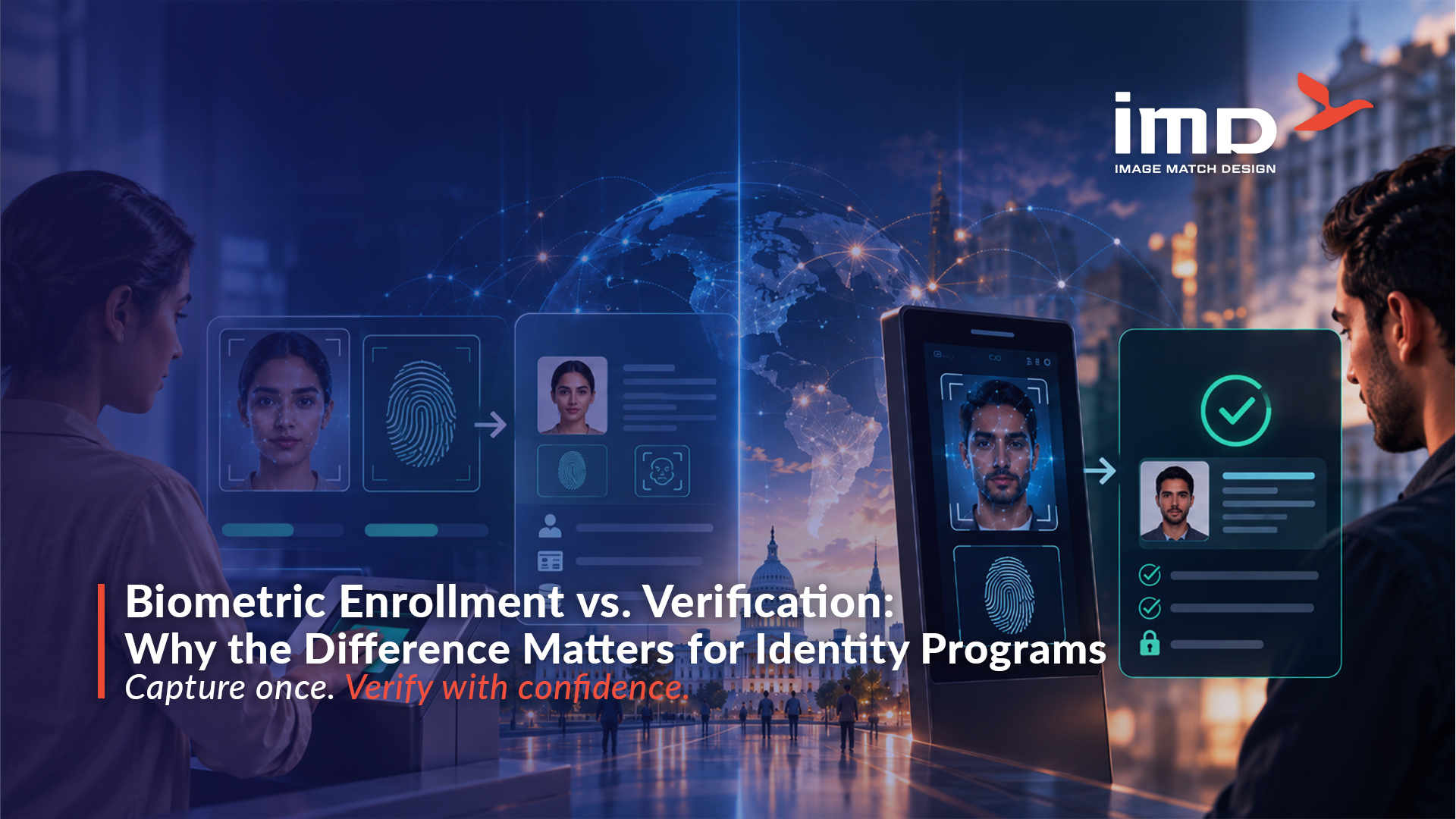
iMD Technical Perspective | October 2026 | Biometric Enrollment Fundamentals
Biometric Enrollment vs. Verification: Why the Difference Matters for Identity Programs
Ask a room of identity program stakeholders what a fingerprint system does and you'll usually hear one word: matching. In practice, a biometric system does three different jobs, and each one puts different demands on the hardware, the software and the people running the field operation. Mixing up biometric enrollment vs verification is one of the more expensive planning mistakes a program can make, because the quality of everything that follows is largely settled at the very first capture.
It matters more now than it did a few years ago. National ID schemes, bank onboarding and border screening are all scaling faster than the enrollment infrastructure behind them. Verification gets the attention because it's what users actually see. Enrollment gets squeezed in the budget because it only happens once per person. That's backwards, and the rest of this article explains why.
The Industry Challenge: Three Operations, One Confusing Vocabulary
Vendors, tenders and even standards documents use enrollment, verification, identification, authentication and deduplication loosely. For planning, three terms are enough, and the World Bank's ID4D biometrics primer draws much the same lines.
Enrollment: creating the record
A person presents their documents, and their biometrics are captured and linked to an identity record. That capture becomes the reference sample every later comparison relies on. It happens once, usually with an operator present, and the sample often needs to stay usable for years.
Verification (1:1): confirming a claim
Someone says who they are, and a fresh capture is compared against that one stored record. The system returns a match score and accepts the claim if the score clears a threshold. Think unlocking a device or approving a payment. It happens constantly, and often with nobody watching.
Identification (1:N): searching the population
A capture is compared against many records, with no identity claim at all, and the system returns a ranked list of candidates. Deduplication at enrollment is exactly this: before a new record is created, the system checks whether the person is already in the database. It runs on servers, but it can only work with what the capture device handed it.
Here's the part that gets overlooked. Enrollment is the only one of the three that creates data. Verification and identification just use it. You can have excellent matching and still let your users down if the enrolled samples are weak.
Technical Breakdown: Why Enrollment Is the Hard One
Capture area and number of fingers
Everyday verification can often run on a single finger and a compact sensor. Enrollment for a population-scale program is a different job. The record has to support one-to-many searches and stay useful for a long time, so programs commonly ask for more data per person, such as four-finger slap captures plus thumbs, or a full ten-print set. That usually means a larger capture area and, in many tenders, a specific image quality tier. The spec details live in our FAP 20 vs. FAP 30 comparison. The planning point is simpler: decide whether the application is enrollment, verification or both before you pick a module. Exact finger counts and image requirements vary by program and are set in each tender.
Image quality, recapture and throughput
An enrollment officer's day is measured in completed records. Every poor capture that has to be repeated eats into that, and at scale those minutes turn into longer queues, extra stations and more field staff. Quality scoring tools like NIST's NFIQ 2 (we cover it in our article on NFIQ 2 fingerprint image quality and sensor procurement) let a program set an acceptance threshold at the moment of capture, so a weak sample gets retaken while the person is still standing there. There's a real trade-off, though. A stricter threshold builds a better database but raises the recapture rate, which is why a sensor's performance on difficult fingers has a direct effect on operating cost. Dry, worn or fine-ridged fingers are more common in some age groups and occupations, and that's where differences between devices tend to show up.
Why matching can't repair a weak capture
A matching algorithm compares the information that's actually in the images it receives. If the enrolled print is partial, smudged or low in contrast, there's simply less ridge detail to work with. You see the effect in two places: genuine users who fail verification later, and returning applicants whose duplicates slip past deduplication. Better algorithms help at the margins, but they can't restore detail that was never captured. That's a general property of biometric systems, not a claim about any one product, and it's why getting quality right at the front end costs less than compensating for it downstream.
Security and Deployment Implications
The two operations run in different places, so most programs end up needing different devices for each. Treat them as one requirement and you either over-specify every verification point or under-specify the enrollment station.
Enrollment stations
Operator-assisted, lower volume per device, often fixed sites or mobile kits working in tough conditions. What matters most: image quality across a diverse population, ruggedness, repeatable capture, and long-term supply so replacement units match the original setup.
Verification points
Higher transaction volume, often unattended or lightly attended, and frequently a single finger. What matters most: speed, compact size, easy integration with the host device, and spoof resistance where the use case calls for it.
The identity back end
Matching and deduplication infrastructure. Its accuracy ceiling is set by the samples it receives, which ties its performance to the capture layer far more tightly than most architecture diagrams suggest.
Security belongs in this split too. Enrollment is the moment a trusted record gets created, so it's where fraud has the most leverage, whether through a duplicate identity or a fake fingerprint presented to the sensor. Programs that use presentation attack detection should think about it at the enrollment station, not only at verification points. For how this fits into national programs, see our national ID and digital identity procurement guide.
What to Look for in a Capture Layer
Without turning this into a product comparison, a few questions separate a capture layer built for enrollment from one adapted from a verification use case. Is the capture area right for the number of fingers the program specifies? Does the device give consistent images on dry, worn and fine-ridged fingers, and can the supplier show test evidence instead of general claims? Are SDK and image tuning options available so the integrator can adjust acquisition behavior? And is long-term supply and support committed? An enrollment fleet usually has to be maintained and extended for years.
iMD's MatriXcan™ platform is a fingerprint sensing platform. It isn't an AI system, and where a reader uses AI or machine learning for spoof detection, that capability belongs to the reader and its software. Within that scope, our focus is the capture layer: sensor, module, firmware and image tuning working together so the first capture is as complete and consistent as the environment allows.
Frequently Asked Questions
+ What is the difference between biometric enrollment and verification?
Enrollment is the one-time step where a person's biometric is captured and linked to an identity record, creating the reference sample. Verification is the later one-to-one comparison of a fresh capture against that stored reference to confirm a claimed identity. Enrollment builds the data, and verification depends on it.
+ What is the difference between biometric verification and identification?
Verification (1:1) answers the question "is this person who they claim to be?" by comparing a live capture with a single stored record. Identification (1:N) answers "who is this, or are they already known?" by searching a capture against many records with no identity claim. Deduplication at enrollment is an identification operation.
+ Why does enrollment usually need a larger fingerprint capture area than verification?
Enrollment records have to last for years and support one-to-many searches, so programs often capture more fingers, such as four-finger slaps plus thumbs or a full ten-print set, to give the matcher more to work with. Everyday verification can often be done with one finger on a smaller sensor. The exact requirements depend on the program's specification and tender.
+ Can a good matching algorithm make up for poor enrollment images?
Only to a limited degree. A matcher can only compare the detail that's in the images it receives. If the enrolled sample is partial, smudged or low in contrast, there's less usable detail, which raises the chance of false non-matches at verification and missed duplicates at deduplication. Capturing well at enrollment is usually cheaper than compensating later.
+ What is failure to enroll (FTE) in a biometric system?
Failure to enroll describes people a system can't capture a usable sample from, for example because of worn ridges, injury or missing fingers. Programs usually plan for it with alternative fingers, additional modalities or documented exception processes, so these people aren't left out.
Conclusion: Verification Is Only as Good as the Enrollment Behind It
Biometric enrollment vs verification isn't just a vocabulary exercise. Enrollment creates the data, verification and identification use it, and no later improvement fully recovers what a weak first capture lost. Program owners who define the application first, size the capture layer to the operation, and track recapture and failure to enroll rates from day one tend to end up with databases that stay useful for the life of the program.
Choosing the right fingerprint module starts with knowing whether your application is enrollment, verification or identification. iMD works with system integrators and device makers on exactly that question, starting from the capture layer.
Planning an Enrollment or Verification Deployment?
Tell us whether your application is enrollment, verification or identification, and our team will talk through fingerprint module options for your project.
Talk to Our Team →
biometric enrollment vs verification
fingerprint enrollment
biometric identification 1:N
deduplication
failure to enroll
fingerprint image quality
fingerprint module
MatriXcan fingerprint technology