

iMD Industry Perspective | September 2026 | Digital Identity Infrastructure
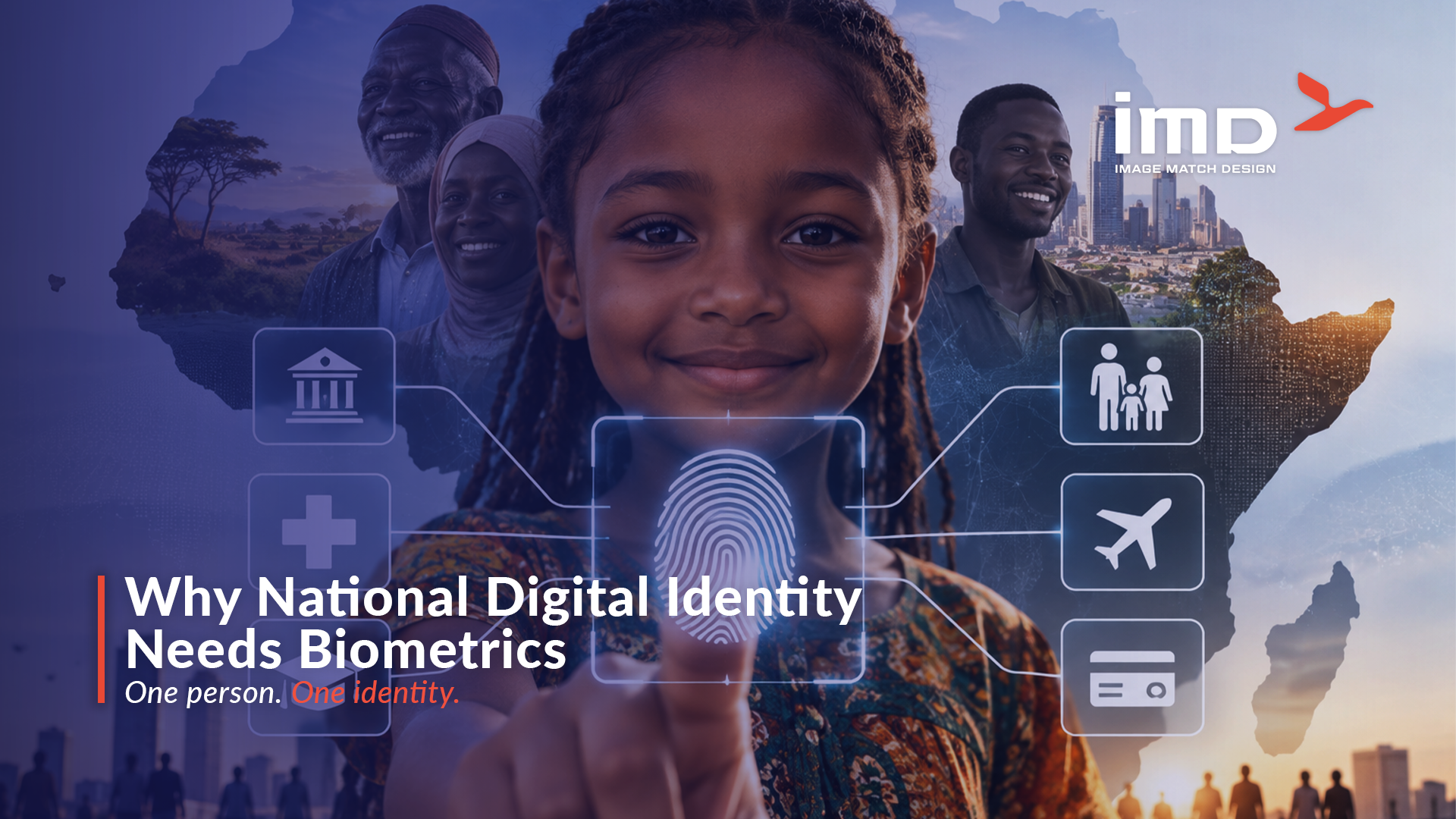
Why National Digital Identity Needs Biometrics
Issuing a national digital ID is the easy part. Any government can print a card, generate a QR code, or push out a mobile credential in a matter of months. What takes years, and what actually decides whether the program works, is the infrastructure behind it: the ability to say with confidence who a person is, and to know that person doesn't already hold a second identity somewhere else in the system.
That guarantee doesn't come from a name and a date of birth. Names get misspelled. They get transliterated three different ways across three different agencies. Birthdates are self-reported, sometimes guessed. Addresses change the moment someone moves. Build a national identity system on that kind of data alone and, at population scale, you end up with duplicates, gaps, and seams that are trivial to exploit. Fingerprint capture has sat at the center of large identity programs for two decades for exactly this reason — it solves the one problem biographic data can't.
This is also roughly the view from where iMD sits. We currently supply fingerprint modules for a national identity enrollment project underway in Africa, and what follows isn't a pitch for that work — it's a plain case for why the hardware layer of identity infrastructure deserves the same scrutiny governments already give the policy and software layers above it.
No official ID
Hundreds of millions of people worldwide still have no officially recognized identification at all, according to World Bank Identification for Development (ID4D) data.
No digital ID access
Billions more have nothing usable for an online or remote transaction, which quietly locks them out of financial services, healthcare and social programs that now assume digital identity as a starting point.
The Industry Challenge: One Person, One Identity
National identity enrollment has one job, and it's harder than it sounds: give every eligible person exactly one identity record, and make sure no one ends up with more than one. Voting, banking, social benefits, healthcare, cross-border travel — all of it depends on that guarantee holding. When it doesn't, you get the failures that show up in the headlines every year: duplicate benefit claims, inflated voter rolls, synthetic identities built to commit fraud, and real citizens locked out of services because the system can't confirm they are who they say they are.
Biometric deduplication — running a new applicant's fingerprints against the entire existing database before a new record gets created — is what turns "one person, one identity" from a policy goal into something the system can actually enforce. At national scale, that's a one-to-many search against tens or sometimes hundreds of millions of records. It's a big part of why fingerprint recognition has stayed the dominant method for large civil registration and national ID programs, even as facial recognition and other modalities have gotten a lot better.
Technical Breakdown: What Fingerprints Contribute That Other Data Cannot
Fingerprint patterns stay stable from early childhood onward, differ even between identical twins, and belong to a physical person rather than a claimed identity on paper. That combination is what makes fingerprints good at a job biographic data simply cannot do: proving that the person sitting across from an enrollment officer today isn't already in the database under a different name.
Enrollment at population scale
Large-scale enrollment typically captures four or ten fingerprints per person, often alongside a face image, both to improve match accuracy and to build in some resilience when a finger is worn, injured or missing. What actually shapes whether that record is still usable for deduplication ten years from now is more mundane than the policy conversation around it: the capture device, the image quality it produces, and the environment it's used in, whether that's a fixed registration center, a mobile kit bouncing along a rural road, or a temporary tent set up after a flood.
Why capture quality isn't a footnote
A matching algorithm, however good, can only compare what it's handed. A smudged or partial capture leaves it with less to work with, which pushes up both kinds of error: a real duplicate that slips through undetected, and a false match that wrongly flags two different people as one. Neither is a small problem. The first lets fraud walk in the front door at enrollment. The second takes a legitimate applicant's identity away from them, sometimes permanently. That's the reason capture quality belongs in the conversation from day one, not as something to tune after the policy design is already locked in.
Deployment Implications: Divided Responsibility, Shared Risk
No single organization pulls off a national identity system by itself, and program teams that quietly assume one party — the government, the integrator, or the hardware vendor — carries all the risk tend to find out the hard way that they were wrong.
Government
Sets the legal framework, decides who the program needs to enroll, and defines data protection and interoperability requirements — often aligning with frameworks like MOSIP or a region's own standards.
Systems Integrator
Builds the enrollment workflow and the matching infrastructure behind it, then runs the field operation — training officers, keeping fixed and mobile sites running, and pulling hardware from one or more suppliers into something that actually works as one system.
Biometric Technology Supplier
Supplies the fingerprint sensors, modules and capture software that everything above depends on. This is where iMD sits, as fingerprint module supplier on national identity enrollment programs using our MatriXcan™ sensing platform — a layer that's easy to skim past during planning and genuinely expensive to discover was undersized after a few million enrollments are already on the books.
A gap in any one layer drags the whole system down with it — a legal framework with no deduplication requirement, an integrator who's never run a field deployment, or a sensor that can't produce a usable image across a genuinely diverse population and a range of harsh conditions. Procurement teams do themselves a favor by holding all three layers to the same standard. If you're specifying the sensor and certification side of this, our guide on fingerprint biometrics for national ID and digital identity procurement goes into more depth, and if you want a sense of just how demanding the field conditions can get, our piece on fingerprint biometrics deployments across Africa's national ID and civil registration programs covers that ground.
Who gets enrolled
Data protection rules
Interoperability standards
Matching & database
Officer training
Fixed & mobile sites
Modules & firmware
Capture software
Image quality at enrollment
Frequently Asked Questions
+ Why does national digital identity need biometrics?
Because names, birthdates and addresses can be duplicated, misspelled or faked, and a digital identity system is only as trustworthy as its guarantee that each record belongs to exactly one real person. Biometrics, and fingerprints especially, let a system check a new applicant against every record already on file and confirm whether that person has already been enrolled. That check is what deduplication and fraud prevention are built on.
+ What is the difference between issuing an ID card and building digital identity infrastructure?
An ID card is a credential. The infrastructure behind it is what makes that credential worth trusting: enrollment, deduplication, verification, data governance. A government can print millions of cards in a matter of months. Building the matching and enrollment systems that guarantee no one holds two identities, and no identity gets claimed by two people, takes considerably longer — and it's the part that decides whether the whole program holds up once it's actually in use.
+ How do fingerprints reduce duplicate registration?
At enrollment, a new applicant's fingerprints get checked against the existing database before any new record is created. That one-to-many search — deduplication — flags whether the person is already in the system under a different name. Fingerprints work well for this because the pattern is stable and distinct from one person to the next, which is more than biographic data alone can offer. It's why fingerprint biometrics has stayed the default deduplication method in large national identity programs.
+ Does capture quality at enrollment really matter for identity fraud prevention?
It matters more than most program plans give it credit for. A matching system can only work with what it's handed. A smudged or partial fingerprint capture raises the odds of a missed duplicate or a false match, and either one undercuts the uniqueness guarantee the whole system depends on. Capture quality is a fraud control at the front door, not a hardware detail to sort out later.
+ Who is responsible for building a national biometric identity system?
It's never one party. Government sets policy, legal frameworks and who the system needs to serve. Systems integrators build and run the enrollment and matching infrastructure. Biometric technology suppliers provide the sensors, modules and capture software that everything downstream relies on. Each layer depends on the others holding up — including the hardware layer, which is easy to treat as an afterthought.
Conclusion: Trust Is Built at Enrollment, Not Printed on a Card
Every national digital identity program eventually gets judged on one question: can this system be trusted to say, correctly, who someone is? That trust doesn't come from the card, the app, or the database schema sitting behind it. It gets built at the moment of enrollment, in whether the biometric data captured that day is accurate and complete enough to keep deduplication and verification working reliably for the decades that record will stay in use.
That's the layer iMD works in, as a fingerprint module supplier building capture technology meant to hold up across the population diversity and field conditions large programs actually run into — including the national identity enrollment project we currently support in Africa. Over the next several weeks, this series will get into enrollment versus verification, what actually makes a fingerprint module government-grade, and how systems integrators should go about evaluating a biometric technology partner.
Developing a National ID or Civil Registration Program?
Is your organization developing a national ID, civil registration or large-scale biometric enrollment solution? Connect with iMD to explore fingerprint technology options for your project.
Talk to Our Team →
national digital identity
biometric deduplication
fingerprint enrollment
civil registration
identity fraud prevention
digital identity infrastructure
MatriXcan fingerprint technology
World Bank ID4D