

iMD Industry Insights | September 2026 | Standards & Sensor Selection
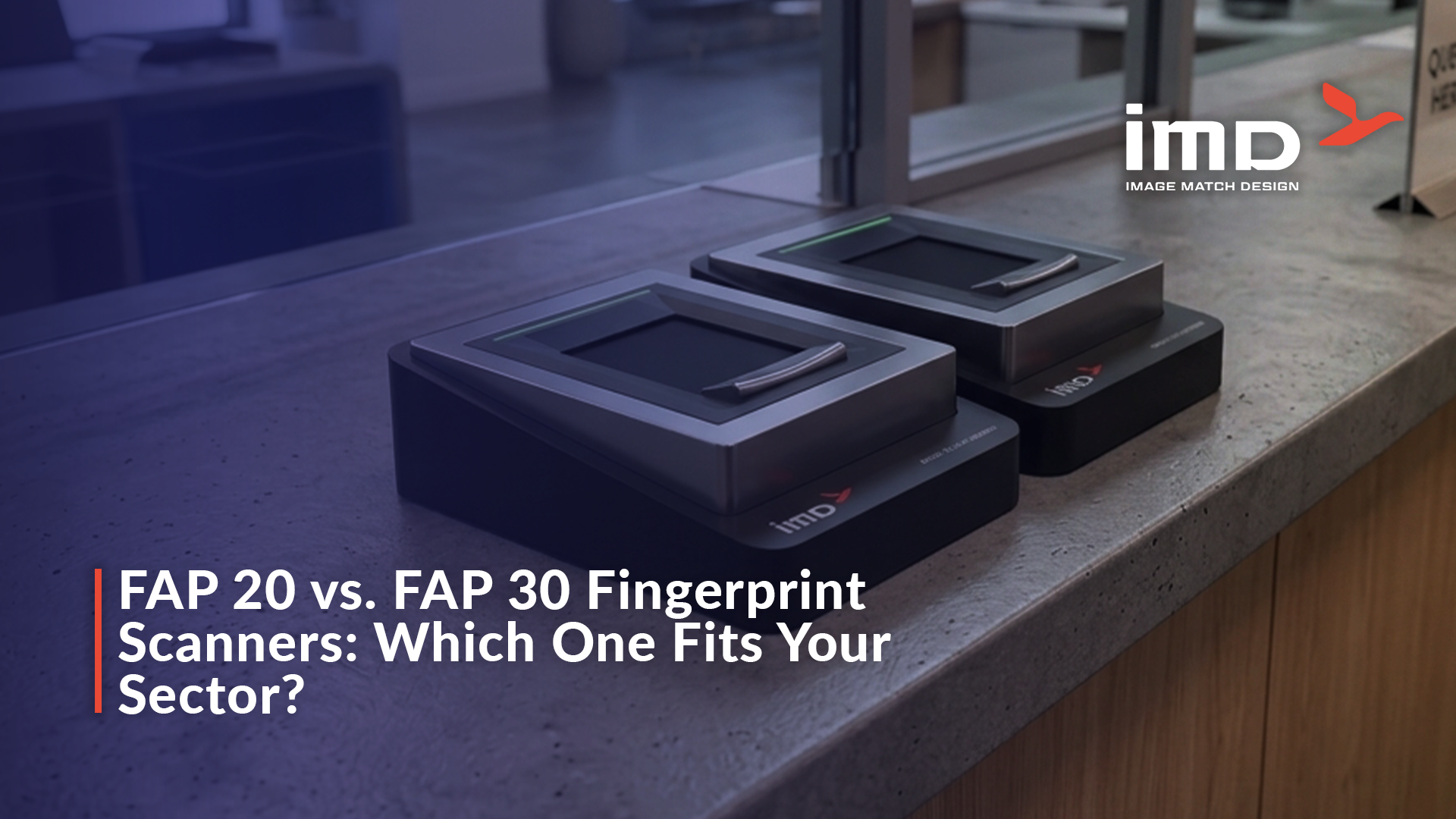
FAP 20 vs. FAP 30 Fingerprint Scanners: Which One Fits Your Sector?
FAP 20 and FAP 30 show up on the same spec sheets, get certified under the same FBI standard, and are frequently treated as interchangeable single-finger options where the buyer simply picks the higher number for margin. That instinct isn't wrong, but it skips the actual question a procurement decision should answer: what does the extra capture area buy a given deployment, and does that sector need it?
Both levels sit under FBI PIV-071006, not FBI Appendix F — a distinction worth stating plainly before comparing them, since Appendix F governs a different class of multi-finger, AFIS-linked hardware entirely. Within the PIV tier, FAP 20 and FAP 30 differ in one dimension: how much finger the sensor sees in a single scan. That single variable has real consequences for which sectors each one fits.
Certification
Both: FBI PIV-071006, single finger, no rolled impression
Image quality
Both: 500 ppi minimum, WSQ 2.0+ compression
FAP 20 platen
≈15.2 × 20.3 mm (0.6 × 0.8 in) — compact footprint
FAP 30 platen
≈20.3 × 25.4 mm (0.8 × 1.0 in) — larger capture margin
Why This Comparison Sits Inside the PIV Tier, Not Appendix F
The FBI's fingerprint certification structure splits into two families. FAP 45, 50, and 60 fall under Appendix F, built for two-to-four-finger flat and rolled capture that feeds one-to-many AFIS and NGI database searches — national ID, law enforcement booking, border enrollment. FAP 10, 20, and 30 fall under PIV-071006, built for single-finger, one-to-one verification: does this finger match the one already on file. Neither FAP 20 nor FAP 30 is a step toward Appendix F capability; they solve a different problem entirely, and no amount of platen size within the PIV tier changes that.
That framing matters because it rules out a common but mistaken shortcut: treating FAP 30 as "almost Appendix F." It isn't. A program that will eventually need AFIS-linked, multi-finger enrollment should specify Appendix F hardware from the start, not assume a FAP 30 sensor bridges the gap later.
The Real Spec Difference: Capture Area, Not Image Quality
Both levels are certified to the same 500 ppi minimum resolution and the same WSQ 2.0+ compression standard. Neither is "sharper" than the other by certification requirement. The entire difference is physical: how much of the finger the sensor's active area covers in one placement.
FAP 20 — INDICUS (GF421)
A compact single-finger sensor built for size-constrained integration. iMD's INDICUS module reads reliably across dry, worn, and wet finger conditions, runs at low power, and carries an IP65 rating for dust and moisture resistance — characteristics that matter most when the sensor has to fit inside a handheld device or an outdoor-rated kiosk enclosure rather than a full-size desktop reader.
FAP 30 — FABALIS (GF631)
A larger single-finger sensor optimized for thumbprint capture, with hardware and software liveness detection support built into the module and UV/strong-light resistance for latent-print handling. The larger platen gives more tolerance for finger size and placement angle, which reduces failure-to-acquire retries in unattended or high-throughput settings.
The practical read: FAP 20 optimizes for footprint and integration flexibility; FAP 30 optimizes for capture consistency across a wider range of fingers and placement behavior. Neither trades away image quality to get there.
Where FAP 20 Fits: Compact, Embedded, and Mobile-First Deployments
FAP 20's smallest advantage — board space — is decisive in several sectors. OEM manufacturers building handheld field-verification devices, wearables, or IoT-connected access endpoints often have a fixed enclosure size before the sensor is even chosen, and every additional millimeter of platen competes with battery, radio, and display. Mobile ID applications, where a field agent performs a quick supervised scan against a known enrollment, tolerate a smaller capture area well because a human is present to correct finger placement if a scan fails. Cost-sensitive, high-volume deployments — volunteer check-in, event access, basic time-and-attendance — also favor FAP 20 where the per-unit hardware cost scales across hundreds or thousands of endpoints.
Where FAP 30 Fits: Higher-Assurance Single-Finger Programs
FAP 30 earns its larger footprint in programs where a failed or marginal scan carries a real cost. Banking and fintech onboarding flows that use fingerprint as a step-up authentication factor during KYC benefit from the lower retry rate, since a frustrated applicant abandoning onboarding is a measurable business cost. Employment and background-screening verification, where a single-finger check against a criminal or identity database needs to hold up to later scrutiny, favors the larger platen's consistency. Secure credential issuance — badges, access cards, licensing programs — and unattended or high-throughput verification points, where no operator is available to coach finger placement, are also better served by FAP 30's larger margin for error.
A Sector-by-Sector Decision Framework
The comparison below is intentionally practical rather than exhaustive — it reflects the deployment pattern each level is generally specified for, not a hard rule.
OEM / embedded devices
FAP 20 — board space and power draw usually dominate the decision
Mobile field verification
FAP 20 — supervised capture tolerates the smaller platen
Volunteer / event check-in
FAP 20 — cost per endpoint scales across high unit counts
Banking / fintech step-up KYC
FAP 30 — lower retry rate protects onboarding conversion
Employment / background screening
FAP 30 — consistency matters when the result will be scrutinized later
Unattended / high-throughput access
FAP 30 — larger margin reduces failure-to-acquire without an operator present
Conclusion
FAP 20 and FAP 30 are not a "better vs. worse" pairing — they are two answers to the same PIV certification tuned for different operating conditions. The question worth asking during specification isn't which number is higher; it's whether the deployment is supervised or unattended, cost-sensitive or assurance-sensitive, and space-constrained or not. Sectors that need compact, mobile, or high-volume capture tend toward FAP 20. Sectors where a failed scan carries onboarding, screening, or compliance consequences tend toward FAP 30.
Both levels remain single-finger, one-to-one verification devices under FBI PIV — a distinct product category from the Appendix F hardware that AFIS-linked national ID and law enforcement programs require. Getting that distinction right, and then matching FAP 20 or FAP 30 to the actual operating conditions of the deployment, is a more useful procurement exercise than defaulting to the larger sensor on the assumption that more capture area is always the safer choice.
+ What is the difference between FAP 20 and FAP 30?
Both are FBI PIV-071006 single-finger certifications at 500 ppi with no rolled-impression requirement, so the underlying test standard is the same. The difference is capture area: FAP 20 uses a roughly 15.2 by 20.3 mm platen, while FAP 30 uses a larger roughly 20.3 by 25.4 mm platen. The larger area gives FAP 30 more tolerance for finger placement variation and larger finger sizes, at the cost of a bigger sensor footprint.
+ Is FAP 30 more accurate than FAP 20?
FAP 30 generally produces more consistent match performance across a broader range of finger sizes and placement angles simply because it captures more ridge area per scan. FAP 20 is not less accurate by certification standard — both pass the same 500 ppi PIV image quality bar — but its smaller platen leaves less margin when a finger is only partially placed, which matters more for large-population or unattended deployments than for supervised one-off checks.
+ Are FAP 20 and FAP 30 scanners FBI Appendix F certified?
No. FAP 20 and FAP 30 are certified under FBI PIV-071006, a separate standard from FBI Appendix F. Appendix F governs the higher tiers — FAP 45, 50, and 60 — built for multi-finger, flat-and-rolled capture that feeds one-to-many AFIS and NGI database searches. FAP 20 and FAP 30 are single-finger, one-to-one verification devices and are not a substitute for Appendix F hardware in programs that require AFIS-linked enrollment.
+ Which sectors typically use FAP 20 fingerprint scanners?
FAP 20's compact footprint suits embedded and mobile-first deployments: OEM integration into handheld devices and kiosks where board space is limited, mobile field-verification apps, IoT-connected access control endpoints, and cost-sensitive volunteer or attendance check-in stations where a supervised, single quick scan is the norm.
+ Which sectors typically use FAP 30 fingerprint scanners?
FAP 30 fits higher-assurance single-finger programs: banking and fintech step-up authentication during KYC onboarding, employment and background-screening verification, secure credential issuance, and unattended or high-throughput points where consistent capture without an operator correcting finger placement matters.
+ Can a FAP 20 deployment be upgraded to FAP 30 later?
Not as a firmware or software change — FAP level is a function of the physical sensor's capture area, so moving from FAP 20 to FAP 30 means swapping the sensor module. Programs that anticipate needing more capture margin later, or that may eventually need to support a broader population, often specify FAP 30 from the outset rather than plan around a hardware swap.
Deciding Between FAP 20 and FAP 30 for Your Program?
iMD's Anser family covers both PIV tiers — INDICUS at FAP 20 and FABALIS at FAP 30 — alongside Appendix F options for programs that need to step up later. Talk to our team about matching a sensor to your sector's actual operating conditions.
Request a Sensor Selection Consultation →
FAP 20 vs FAP 30
FBI PIV fingerprint certification
single-finger fingerprint scanner
INDICUS
FABALIS
fingerprint sensor sector fit
mobile ID fingerprint reader