

iMD Industry Insights | July 2026 | Government & Elections
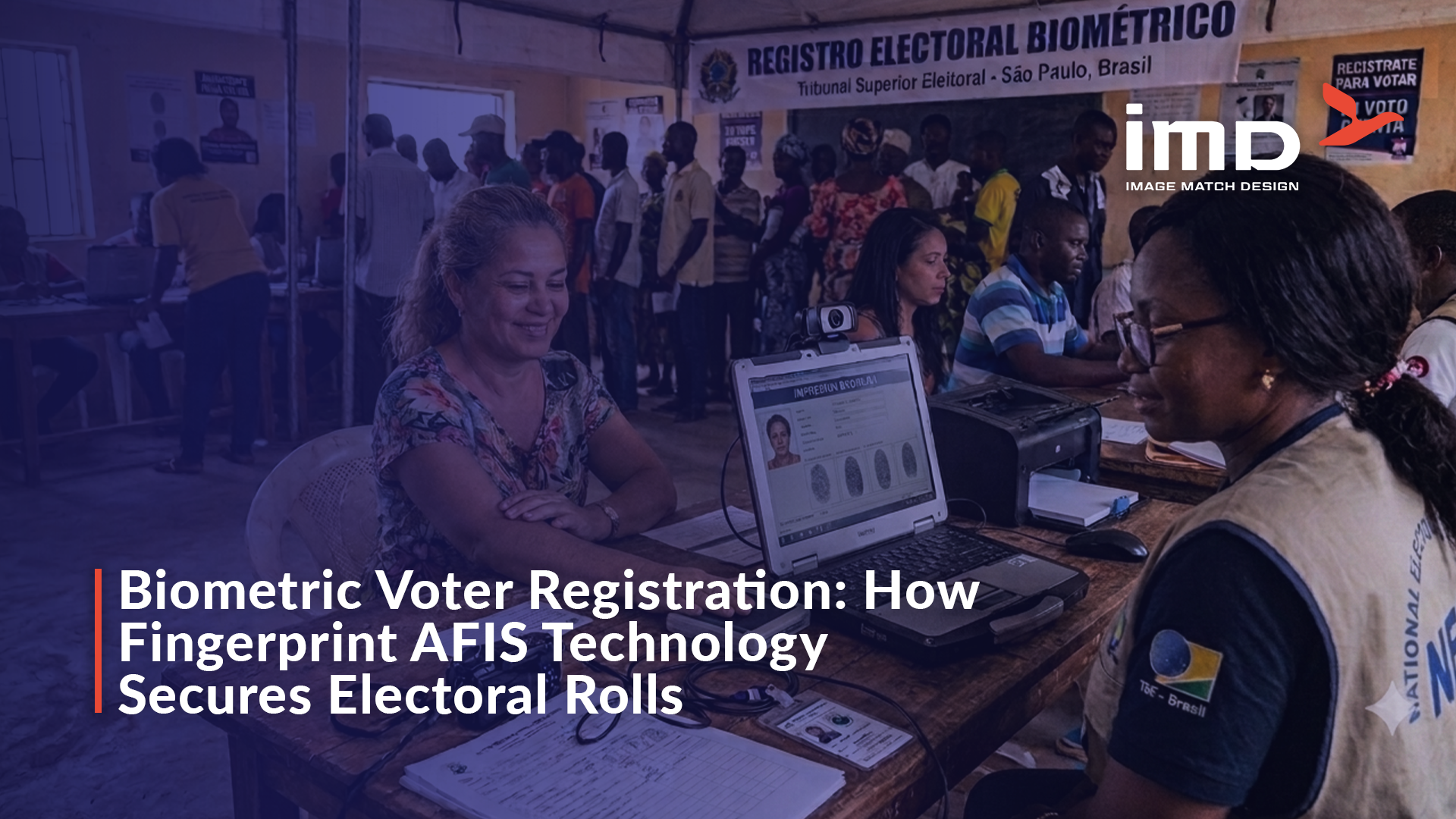
Biometric Voter Registration: How Fingerprint AFIS Technology Secures Electoral Rolls
Every national election starts with a basic question a registry has to answer correctly: is this person already on the roll under a different name? Manual and even early digital voter registries struggled to answer that question at scale, leaving room for duplicate entries, ghost voters, and disputed results. Fingerprint-based Automated Fingerprint Identification Systems (AFIS) were built to answer it deterministically, and election management bodies have adopted them faster than almost any other government biometric use case.
According to International IDEA's global elections database, roughly 35% of 130 surveyed countries now capture biometric data — most commonly fingerprints — as part of voter registration, with concentrated adoption across Africa, West Asia, and Latin America. Nigeria's electoral commission used AFIS to identify and remove millions of duplicate entries from a decentralized voter register. Bangladesh registered more than 80 million citizens using combined fingerprint and facial capture. These are not pilot programs; they are the operational backbone of how large democracies now build trustworthy voter rolls.
For system integrators and government procurement teams, the fingerprint sensor is the least visible part of this chain — and the part where errors compound. A sensor that fails to capture usable minutiae from a manual laborer's worn ridges, or that performs inconsistently across a country's diverse population, doesn't just create an inconvenience. It creates gaps in the roll, adjudication backlogs, and disputes that outlast the election cycle. This is the same accuracy and durability problem national ID and civil registration programs have had to solve for years — iMD's fingerprint sensing work in that space, including the MatriXcan™ platform, is one illustration of how the underlying engineering challenge translates directly to voter registration infrastructure.
Global Adoption
~35% of 130 countries surveyed capture biometric data at voter registration (International IDEA)
Regional Concentration
Predominant in Africa, West Asia, and Latin America; 28 African countries use biometrics to generate voter rolls
Nigeria
AFIS-based deduplication identified and removed millions of duplicate entries from the national voter register
Bangladesh
Over 80 million citizens enrolled using combined fingerprint and facial biometric capture
The Core Challenge: Duplicate and Ghost Voters
Before biometrics, voter registers relied on demographic matching — name, date of birth, address — to catch duplicate entries. That approach fails predictably: names are transliterated inconsistently, addresses change, and deliberate fraud can exploit minor spelling variations to register the same person multiple times. In post-conflict or rapidly urbanizing countries, where civil registries are incomplete and internal migration is high, demographic-only deduplication breaks down further.
Fingerprints solve this because they are a biological identifier, not a self-reported one. A person cannot register twice under different names if the underlying fingerprint pattern is compared against every existing entry in the database at the point of enrollment. This shifts deduplication from a probabilistic, error-prone demographic exercise to a deterministic biometric one — provided the underlying capture hardware and matching algorithm perform reliably across the full range of a country's population and field conditions.
How Fingerprint AFIS Deduplication Works
The workflow behind biometric voter registration follows a consistent pattern across most national deployments. At the enrollment station, a fingerprint sensor captures one or more prints and extracts minutiae — the ridge endings and bifurcations unique to each print — into a digital template. That template, not a raw image, is what gets compared and stored in most modern systems, which reduces both storage size and exposure if a database is compromised.
The AFIS or ABIS (Automated Biometric Identification System) platform then runs a one-to-many (1:N) search against every record already in the database, not just a single reference record. A match above a defined similarity threshold gets flagged for manual adjudication rather than automatic rejection — human review stays in the loop because false positives carry real consequences for a citizen's right to vote. On election day, some countries add a lighter-weight 1:1 step: verifying the voter presenting themselves matches the fingerprint on file for that specific registration record.
Deduplication accuracy at national scale depends less on the matching algorithm alone and more on the quality of the fingerprint image captured in the first place. Low-quality captures increase both false non-matches (a real duplicate that goes undetected) and false matches (two different citizens incorrectly flagged as the same person). This is why sensor-level image quality, not just backend matching software, is treated as a first-order procurement requirement by election management bodies rather than a hardware afterthought.
Deployment Realities: Field Conditions and Population Diversity
Voter registration drives run in conditions that stress hardware in ways a controlled lab environment does not. Rural enrollment centers run on generator power or battery packs; dust, heat, and humidity affect optical and capacitive sensors differently; and enrollment teams process fingerprints ranging from a young adult's clear ridges to an agricultural worker's worn or scarred prints to an elderly citizen's thinner, drier skin. A sensor tuned primarily for one population profile can produce a measurably higher failure-to-enroll rate on others — a quiet but consequential source of voter disenfranchisement if left unaddressed.
This is the same cross-population accuracy and environmental resilience challenge that shapes national ID and civil registration deployments across Africa and Southeast Asia, where iMD's Anser-family sensors are used. Fingerprint readers used in these programs may incorporate AI/ML models to support image quality assessment and presentation attack detection, but the sensing hardware itself is not an AI system — the distinction matters for agencies evaluating vendor claims during procurement, since "AI-powered" is sometimes used loosely in vendor marketing without describing what the software actually does.
Choosing Fingerprint Technology for Election-Grade Deployments
Election management bodies and their integration partners are generally evaluating fingerprint capture hardware against a similar set of criteria, regardless of which vendor they ultimately select:
Standards Compliance
FBI-certified capture devices and ISO/IEC image quality benchmarks give procurement teams an independent basis for comparing sensors. Appendix F and FBI PIV are separate certification tracks, and vendors typically certify individual models against one or the other — iMD's Anser family, for instance, includes the ROSSII Plus (FAP 50 Appendix F) and the FABALIS (PIV), reflecting how capture devices get matched to a program's specific certification requirement.
Cross-Population Accuracy
Field pilots across the actual demographic and occupational range of the electorate — not a single reference population — are the only reliable way to validate failure-to-enroll and failure-to-match rates before national rollout.
Interoperability with Existing ABIS Infrastructure
Countries that already operate a national ID or civil registration ABIS gain significant cost and timeline advantages by extending that matching infrastructure to voter rolls, rather than procuring a parallel system.
Field Durability and Offline Capability
Sensors and enrollment kits need to function reliably without continuous connectivity, tolerate temperature and dust extremes, and hold up through months of high-volume registration drives ahead of election day.
Conclusion
Biometric voter registration has moved from experimental to standard practice across a large share of the world's democracies because fingerprint-based AFIS deduplication solves one specific, high-stakes problem — preventing the same person from appearing on the roll under more than one identity — more reliably than demographic matching alone. It is not a solution to every category of election fraud, and treating it as one risks both overstating its guarantees and understating the diligence it requires around sensor accuracy, population coverage, and data governance.
Programs that get this right tend to treat fingerprint sensing as core infrastructure rather than a commodity peripheral — the same standard applied to national ID and civil registration deployments, where a single missed enrollment or false match carries real institutional weight. Whether a program is building a first-time biometric voter roll or extending an existing national ID ABIS to cover elections, the same underlying question applies: does the sensor perform consistently across every citizen it will ever be asked to identify?
Frequently Asked Questions
+ Can biometric fingerprint registration prevent all forms of election fraud?
No. AFIS is effective at preventing one specific category of fraud — duplicate or multiple voter registrations under different identities. It does not address ballot stuffing, result tampering, coercion, or vote buying, which require separate procedural and legal safeguards.
+ How does AFIS detect duplicate voter registrations?
At enrollment, a sensor captures minutiae from a citizen's fingerprints. The AFIS platform runs a one-to-many search against the full voter database; matches above a defined confidence threshold are flagged for manual adjudication before the registration is finalized.
+ What happens when a citizen's fingerprints cannot be captured or matched reliably?
Worn ridges, age-related skin changes, and certain skin conditions can degrade capture quality. Election bodies typically use fallback paths — additional fingers, enhanced-capture algorithms, or documented manual review — so no eligible citizen is excluded due to a sensor read failure.
+ Is biometric voter data secure, and can it be reused for other purposes?
That depends on the legal framework each country sets before deployment. Best practice is storing encrypted biometric templates rather than raw images, with statutory limits on sharing between the electoral register and other systems — terms procurement teams should confirm before rollout.
+ How much does biometric voter registration cost to deploy at national scale?
Cost varies by country size, existing civil registry infrastructure, and procurement model. Major drivers include sensor/kit pricing, AFIS/ABIS licensing, field logistics, and maintenance. Reusing infrastructure already deployed for national ID programs can meaningfully lower the incremental cost.
Planning a Biometric Voter Registration Program?
Talk to iMD about fingerprint sensing technology engineered for cross-population accuracy and field-grade reliability in large-scale government deployments.
Contact Our Team →
Biometric Voter Registration
AFIS
Fingerprint Deduplication
Election Technology
Civil Registration
MatriXcan
National ID
Government Procurement