

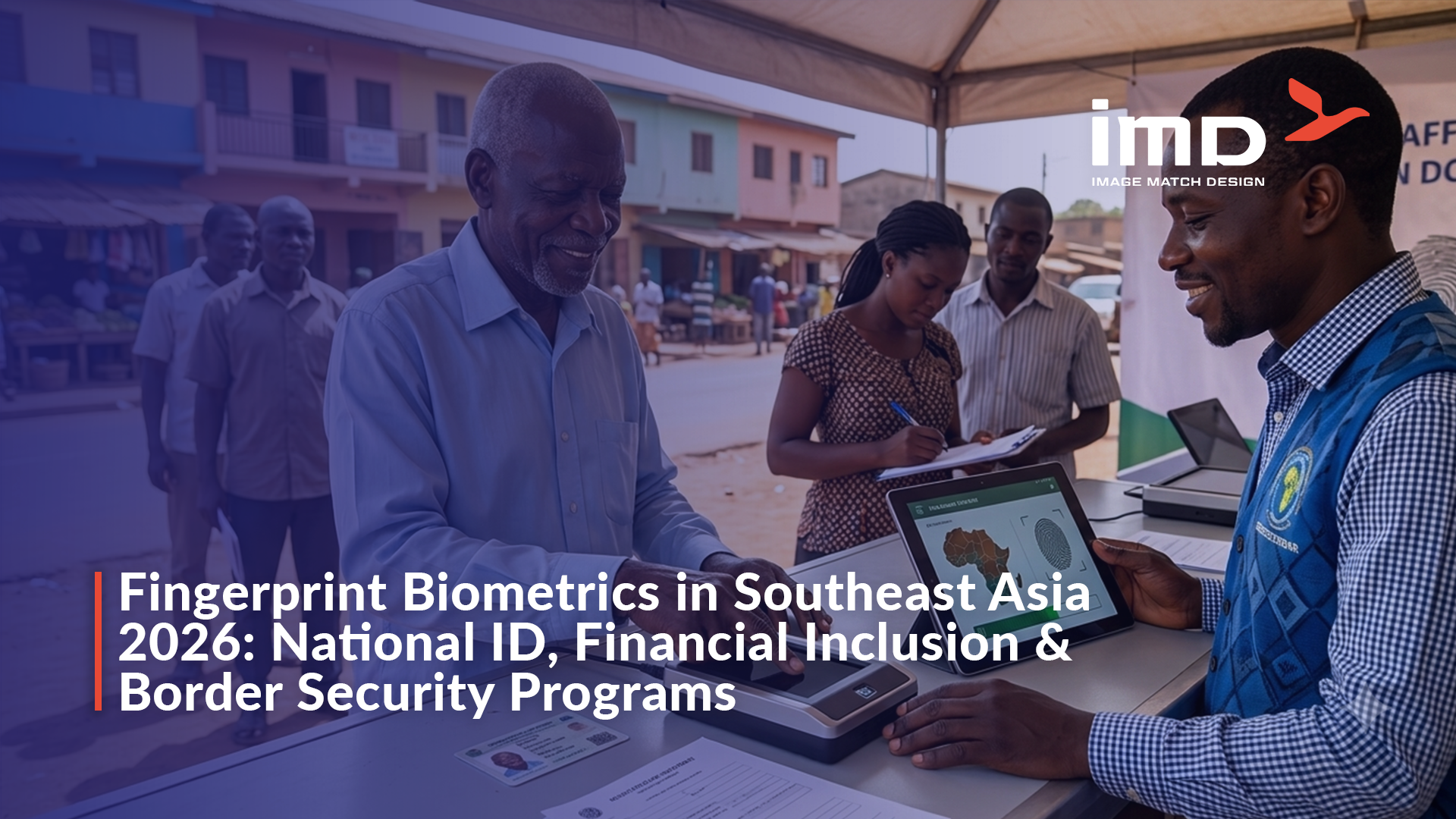
iMD Industry Insight | July 2026 | Regional Market Analysis
Fingerprint Biometrics in Africa 2026: National ID, Civil Registration & the Continent's Biometric Infrastructure Boom
Africa is running the largest digital identity buildout of any region in 2026, and fingerprint biometrics sit at the center of it. South Africa has committed to a national digital ID before year-end, Ghana's GhanaCard has enrolled roughly 19 million people, and more than 2,300 identity stakeholders converged on Abidjan in May for ID4Africa's 2026 AGM — the largest and most Africa-led edition of the event yet. This isn't a rollout of imported systems; it's a continent increasingly designing its own digital identity infrastructure.
Underneath the national ID headlines sits a harder problem: civil registration. Roughly 90 million of the world's 150 million unregistered children under five live in Sub-Saharan Africa, where the birth registration rate hovers around 51% — and drops to about 45% in West and Central Africa. A national ID system built on an incomplete civil registry inherits that gap. Closing it requires biometric technology that performs reliably where enrollment actually happens: outdoor stations, mobile units, inconsistent power, and a population whose ridge conditions and skin characteristics span a wider range than most sensors are validated against. This is the operational reality iMD designs MatriXcan™ fingerprint sensing technology to meet, and the context behind iMD's presence at ID4Africa 2026 in Abidjan.
ID4Africa 2026 AGM
Abidjan, May 12–15 — 2,300+ stakeholders, 148 solution providers, 70% African speakers (a first)
South Africa
National digital ID committed for launch before the end of 2026
Ghana
GhanaCard has enrolled ~19 million people, roughly 95% of the adult population
Civil registration gap
~90 million of the world's 150 million unregistered children under five are in Sub-Saharan Africa
Africa's Digital Identity Moment: Why 2026 Is Different
ID4Africa's 12th AGM, held in Abidjan under the theme "Digital Identity: From DPI to Digital Public Ecosystems," was the organization's most ambitious program to date — six session tracks covering banking, cybersecurity, refugee inclusion, and the integration of civil registration with digital identity. What stood out wasn't just the scale but who was doing the talking: 80% of government delegates were senior officials, and 70% of speakers were African, the highest share in the event's history. Rather than adapting identity frameworks built for other regions, African governments and vendors are increasingly setting requirements around the continent's own population diversity, infrastructure constraints, and inclusion priorities.
Country-level progress backs this up. Senegal has required biometric fingerprint-based digital ID since 2016 for phone numbers, bank accounts, and public services. Ghana's GhanaCard program enrolled around 19 million people — roughly 95% of the adult population — between 2017 and 2025. South Africa's president has committed to launching a national digital ID and mobile driver's license before the end of 2026, with biometric authentication enabling remote identity verification. Benin's National Agency for Identification of Persons (ANIP) now unifies identity management, population registration, and electoral registration under a single civil registrar.
The Civil Registration Gap Biometric ID Must Close
National ID systems are only as complete as the civil registry beneath them. Globally, around 150 million children under five remain unregistered and effectively invisible to government systems. Sub-Saharan Africa accounts for the majority of this gap: a regional birth registration rate near 51%, and as low as 45% in West and Central Africa. Some countries show what's achievable — Botswana has reached universal birth registration, and Côte d'Ivoire has surpassed 90% — but the regional picture remains uneven.
UNICEF's response has been to push digital registration solutions that integrate birth registration directly with health and national identity systems, rather than running them as separate bureaucratic processes. This is where fingerprint biometric infrastructure becomes relevant beyond national ID card issuance: durable, field-deployable enrollment is what lets a government link an identity record forward through a person's life — from registered birth through school enrollment, healthcare access, and eventually a national ID or voter record. Without that continuity, national ID programs risk re-creating the same undocumented population they were meant to formalize.
Technical Breakdown: What Fingerprint Sensing Needs to Handle Africa's Population and Environmental Diversity
Enrollment at national scale rarely happens in a climate-controlled office. Mobile units serving rural populations operate in heat, dust, and humidity, often with inconsistent power and connectivity — conditions that push consumer-grade sensors toward higher failure rates. A sensor built for this environment needs resilience to dust and moisture, stable performance across temperature swings, and the ability to function without a constant network connection.
Population diversity compounds the challenge. Ridge conditions vary significantly across a population that includes manual laborers and agricultural workers, whose fingerprints often show more wear than a typical office-based enrollment population. A sensor validated primarily on a narrow demographic shows measurably higher false-reject rates across this diversity, pushing large programs toward weaker fallback verification — undermining the security the biometric layer was meant to provide. Cross-population accuracy belongs in procurement requirements, not a vendor talking point — the specific differentiator MatriXcan™ sensor technology from iMD is engineered around.
Environmental Resilience
Sensor hardware engineered to maintain accuracy across heat, dust, and humidity — the conditions typical of field and mobile enrollment stations rather than office environments.
Cross-Population Accuracy
Fingerprint sensing tuned and validated across a wide range of ridge conditions and skin characteristics, reducing false-reject rates that would otherwise force fallback to weaker verification.
Security & Deployment Implications: Interoperability and the African Union's Digital ID Framework
National ID systems that work well in isolation still face a harder problem once trade, labor mobility, and migration cross borders. The African Union Commission has been developing a Digital ID Framework to address exactly this — not a single continent-wide identity system, but a template of common requirements, minimum technical standards, and governance principles that let each country's existing system interoperate with others, while keeping control of personal and biometric data with the individual and their own government.
Regional initiatives add another layer: the ECOWAS biometric ID card and the East African Community's e-passport both need to interact cleanly with each member country's system. Officials from Benin, Ethiopia, the DRC, and Tunisia have called for stronger coordination on regulatory harmonization, and uneven investment in privacy-enhancing technology remains a recurring obstacle. The requirement for vendors is clear: build to internationally recognized standards from the outset, so systems don't need re-engineering later to interoperate regionally.
What Governments and Integrators Should Require From a Biometric Vendor in Africa
Given the scale and diversity of what's being deployed, a defensible procurement standard should require documented accuracy data specific to the population being served, hardware validated for field and mobile enrollment conditions rather than office use, and sensor design built to standards such as ISO/IEC 30107-3 for presentation attack detection — with regional interoperability (ECOWAS, EAC, the AU's emerging framework) planned for from the outset rather than retrofitted later. This is the standard iMD builds MatriXcan™ fingerprint sensing technology to meet, and the reasoning behind iMD's presence at ID4Africa 2026 in Abidjan.
Frequently Asked Questions
+ What is the state of digital identity in Africa in 2026?
Africa is mid-way through its largest digital identity buildout to date. South Africa has committed to a national digital ID before the end of 2026, Ghana's GhanaCard has enrolled roughly 19 million people, and Senegal has required biometric fingerprint-based ID since 2016. ID4Africa's 2026 AGM in Abidjan drew more than 2,300 stakeholders and 148 solution providers, with 70% of speakers African for the first time — a sign the continent is increasingly setting its own digital ID agenda.
+ Why is civil registration important for national ID programs in Africa?
Civil registration is the foundational record a national ID system builds on. Sub-Saharan Africa's birth registration rate sits near 51%, and West and Central Africa is lower still at about 45%, leaving tens of millions of children undocumented. Without a registered birth, there's no anchor record to link a fingerprint or ID number to later — which is why registration and identity systems are increasingly being integrated rather than run separately.
+ How does fingerprint biometric technology support Africa's national ID rollout?
Fingerprint capture gives large-scale ID programs a durable, low-cost way to verify identity in the field, including rural areas without reliable connectivity or power. Effective deployment requires sensors validated for accuracy across different ridge conditions and skin tones, and hardened against heat, dust, and humidity, since enrollment often happens outdoors or in mobile units.
+ What is the African Union's digital ID framework?
It's not a single continent-wide ID system. The AU Commission's Digital ID Framework is a template of common requirements, minimum standards, and governance principles that let each country's existing national ID system interoperate with others — supporting cross-border trade, labor mobility, and migration while letting individual nations keep control of their own systems and biometric data.
+ What challenges do African countries face with biometric ID interoperability?
Regional initiatives such as the ECOWAS biometric ID card and the East African Community e-passport need to interact cleanly with each country's national system, requiring harmonized legal frameworks and shared technical standards. Uneven investment in privacy-enhancing technology and data protection legislation has also been flagged by multiple governments as a barrier to trustworthy cross-border identity sharing.
+ Why does cross-population accuracy matter for fingerprint sensors deployed in Africa?
A sensor tuned and validated on a narrow demographic shows higher false-reject rates across a genuinely diverse population, including manual laborers with worn ridge detail and a wide range of skin tones and moisture levels. Higher false-reject rates push large enrollment programs toward weaker fallback methods, so population-specific accuracy data is a baseline procurement requirement, not a nice-to-have.
Africa's 2026 digital identity buildout is being designed on the continent's own terms, and it exposes exactly what fingerprint biometric infrastructure needs to work at this scale: durability across difficult field conditions, accuracy validated across real population diversity, and hardware built to interoperate as regional standards mature. Government identity programs, development partners, and systems integrators evaluating vendors for national ID or civil registration deployments should treat these as baseline requirements — the standard iMD builds MatriXcan™ sensing technology to meet, and the reason iMD showed up in Abidjan for ID4Africa 2026.
Planning a National ID or Civil Registration Deployment in Africa?
Talk to iMD about fingerprint sensor hardware built for field conditions and cross-population accuracy.
Request a Consultation →
Fingerprint Biometrics Africa
National ID
Civil Registration
African Union Digital ID
ID4Africa
MatriXcan