

iMD Market Analysis | June 2026 | Regional Biometrics
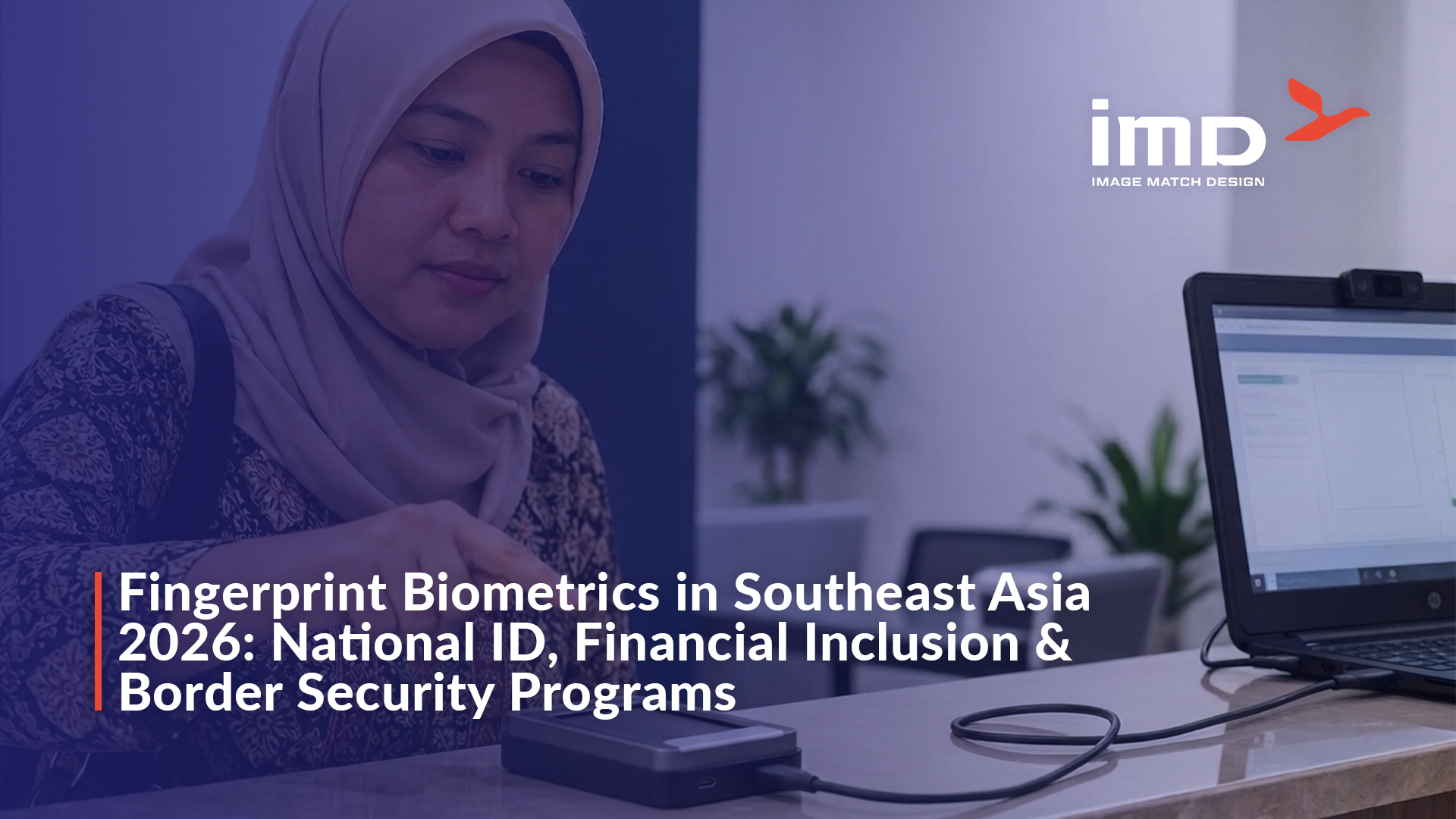
Fingerprint Biometrics in Southeast Asia 2026: National ID, Financial Inclusion & Border Security Programs
Southeast Asia has become one of the most active regions in the world for fingerprint biometrics deployment. Across the Philippines, Malaysia, and Indonesia, three distinct programs — national identity, regulated digital finance, and cross-border travel — are converging on the same operational requirement: reliable, standards-aligned biometric capture at population scale.
For government identity program managers, FinTech security teams, and systems integrators, 2026 is a procurement inflection point. Regulation is no longer encouraging biometrics — in several markets it now mandates them. This analysis maps the regional landscape, the technical demands it places on fingerprint hardware, and where MatriXcan™ fits.
Market trajectory
APAC government & security biometrics market projected to grow from ~USD 6.4B (2024) to ~USD 13.1B by 2029 (CAGR ~15.4%).
Philippines
BSP Circular 1213 requires biometric / passwordless authentication for high-risk bank transactions by 25 June 2026.
Malaysia
MyDigital ID targeting ~17M users by end-2026, with 18 banks in Bank Negara–overseen eKYC testing.
Indonesia
IKD digital identity becoming the sole authoritative ID verification channel from January 2026, backed by a USD 250M World Bank commitment.
The Regional Challenge: Inclusion, Fraud, and Scale
Southeast Asia's biometric momentum is driven by a dual mandate. On one side is financial inclusion — bringing hundreds of millions of citizens, many without traditional documents, into formal banking and government services. On the other is fraud prevention — closing the authentication gaps that have made the region a target for account-takeover and social-engineering scams.
Fingerprint biometrics sit at the intersection of both goals. A fingerprint can serve as a person's first verifiable credential during national ID enrollment and, later, as a phishing-resistant authentication factor for high-value transactions. That dual role explains why identity agencies and central banks are moving in parallel rather than in isolation.
The scale, however, is unforgiving. Programs must enroll and verify across diverse populations, in tropical field conditions, and against adversaries who increasingly test systems with spoofing and presentation attacks. Capture quality and resilience — not just matching accuracy — determine whether a deployment succeeds.
Country Momentum: Three Programs, One Direction
Philippines — Regulation Forces the Shift
Under BSP Circular 1213, issued in May 2025, banks and e-wallet operators must replace SMS- and email-based OTPs for high-risk transactions with stronger methods — biometric, behavioral, or FIDO passwordless — on or before 25 June 2026. In parallel, the PhilSys national ID program captures full biometrics at defined ages and links banks to its biometric database for one-ID account onboarding, tying identity proofing and transaction security into a single credential.
Malaysia — eKYC at National Scale
MyDigital ID, overseen alongside Bank Negara Malaysia, allows users to approve access requests with biometric authentication — including fingerprint — on a registered device. After an initial banking sandbox in 2025, a second phase with 18 banks ran toward a March 2026 readiness assessment. With registrations approaching 10 million in early 2026 and a 17-million target by year-end, eKYC onboarding is moving from pilot to production.
Indonesia — Digital Identity Becomes Authoritative
Building on the eKTP foundation, Indonesia's Identitas Kependudukan Digital (IKD) is being positioned as the authoritative channel for verifying document authenticity from January 2026, enhanced with biometrics, facial recognition, and liveness detection. A USD 250 million World Bank commitment is funding verification systems and eKYC infrastructure, signaling sustained investment in biometric capture and matching capacity.
Above the country level, ASEAN is advancing a regional biometric travel corridor — linking airport facial recognition, contactless immigration, and shared digital travel data — alongside cross-border digital business identity initiatives. Border control and trade facilitation are becoming biometric by default.
Technical Breakdown: What These Deployments Demand
A program that spans civil registration, banking eKYC, and border checkpoints places a specific set of demands on fingerprint hardware. Three requirements stand out.
1. Cross-population capture quality
Fingerprint characteristics vary with age, manual labor, and skin condition. Sensors must produce consistent, high-quality images across worn, dry, or moist fingerprints so that enrollment deduplication and later verification remain reliable for the entire population — not just the easy cases.
2. Environmental resilience
Enrollment often happens in mobile units, rural offices, and outdoor settings under high heat and humidity. Hardware must hold capture performance in conditions that degrade lower-grade sensors, because re-enrollment at scale is costly and erodes public trust.
3. Anti-spoofing and presentation-attack detection
As biometrics replace OTPs in high-value finance, fake fingerprints and presentation attacks become a direct fraud vector. Modern fingerprint readers increasingly apply AI/ML-based liveness and presentation-attack detection (PAD) to distinguish a live finger from a spoof — a sensing-plus-detection model where the capture layer and the analytical layer work together.
Deployment Implications & Differentiation
For integrators and procurement officers, the lesson from these programs is that hardware selection is a long-horizon decision. A sensor chosen for a national ID rollout will likely be reused for eKYC and, eventually, border or service-access verification. Interoperability with recognized image-quality standards is therefore essential for data to remain portable across systems and agencies.
This is where MatriXcan™ is positioned. iMD's fingerprint sensing technology is engineered for cross-population accuracy and environmental resilience — the two attributes that most often separate a smooth deployment from a troubled one in tropical, high-volume conditions. MatriXcan™ supports the capture quality and standards alignment that national ID and eKYC workflows require, and pairs with reader-level AI/ML liveness and PAD where anti-spoofing is critical.
It is worth stating plainly: MatriXcan™ is a sensing platform, not an artificial intelligence system. Its value is dependable, repeatable fingerprint capture — the foundation that any downstream matching, deduplication, or AI-based spoof detection depends on. For a region standardizing identity infrastructure for the next decade, that foundation matters more than any single feature claim. For related context, see our guide to choosing a fingerprint sensor for government and enterprise deployment and our national ID procurement guide.
Frequently Asked Questions
+ Why is Southeast Asia adopting fingerprint biometrics so quickly in 2026?
National ID and civil registration programs, a regulatory push toward phishing-resistant banking authentication, and ASEAN-level border modernization are converging at once. The Asia-Pacific government and security biometrics market is forecast to roughly double, from about USD 6.4 billion in 2024 to USD 13.1 billion by 2029, with Southeast Asia among the fastest-moving segments.
+ What is BSP Circular 1213 and how does it affect biometric authentication?
Issued by the Bangko Sentral ng Pilipinas in May 2025, Circular 1213 requires supervised banks and e-wallet operators to replace SMS- and email-based OTPs for high-risk transactions with stronger methods — biometric, behavioral, or FIDO passwordless — on or before 25 June 2026. It effectively makes biometric factors central to compliant transaction security.
+ How is fingerprint biometrics used in national ID programs like PhilSys and IKD?
Fingerprints are captured during enrollment to establish a unique, deduplicated identity, then used to verify citizens when they open accounts, claim benefits, or access services. PhilSys captures full biometrics at defined ages and links banks to its biometric database for one-ID onboarding, while Indonesia's IKD layers biometrics, facial recognition, and liveness detection onto the eKTP foundation.
+ What makes fingerprint sensors challenging to deploy in Southeast Asia?
Deployments must perform across high heat and humidity, dusty or rural field conditions, and highly diverse populations whose fingerprints vary by age, occupation, and skin condition. Hardware must deliver consistent capture quality, resist presentation attacks, and meet recognized image-quality standards for interoperability with national databases.
+ How does MatriXcan™ support biometric programs in the region?
MatriXcan™ is iMD's fingerprint sensing technology engineered for cross-population accuracy, environmental resilience, and standards-aligned capture quality. It supports enrollment and verification across national ID, eKYC, and border use cases, and pairs with reader-level AI/ML liveness and presentation-attack detection — though MatriXcan™ itself is a sensing platform, not an AI system.
Planning a biometric deployment in Southeast Asia?
Talk to iMD about MatriXcan™ for national ID enrollment, eKYC, and border programs — built for cross-population accuracy and field resilience.
Contact Us About MatriXcan™ →
fingerprint biometrics Southeast Asia
Philippines PhilSys biometric
Malaysia eKYC fingerprint
Indonesia national ID biometrics
SE Asia digital identity 2026
ASEAN biometric border control
MatriXcan