

iMD Technical Insight | June 2026 | Product Feature Article
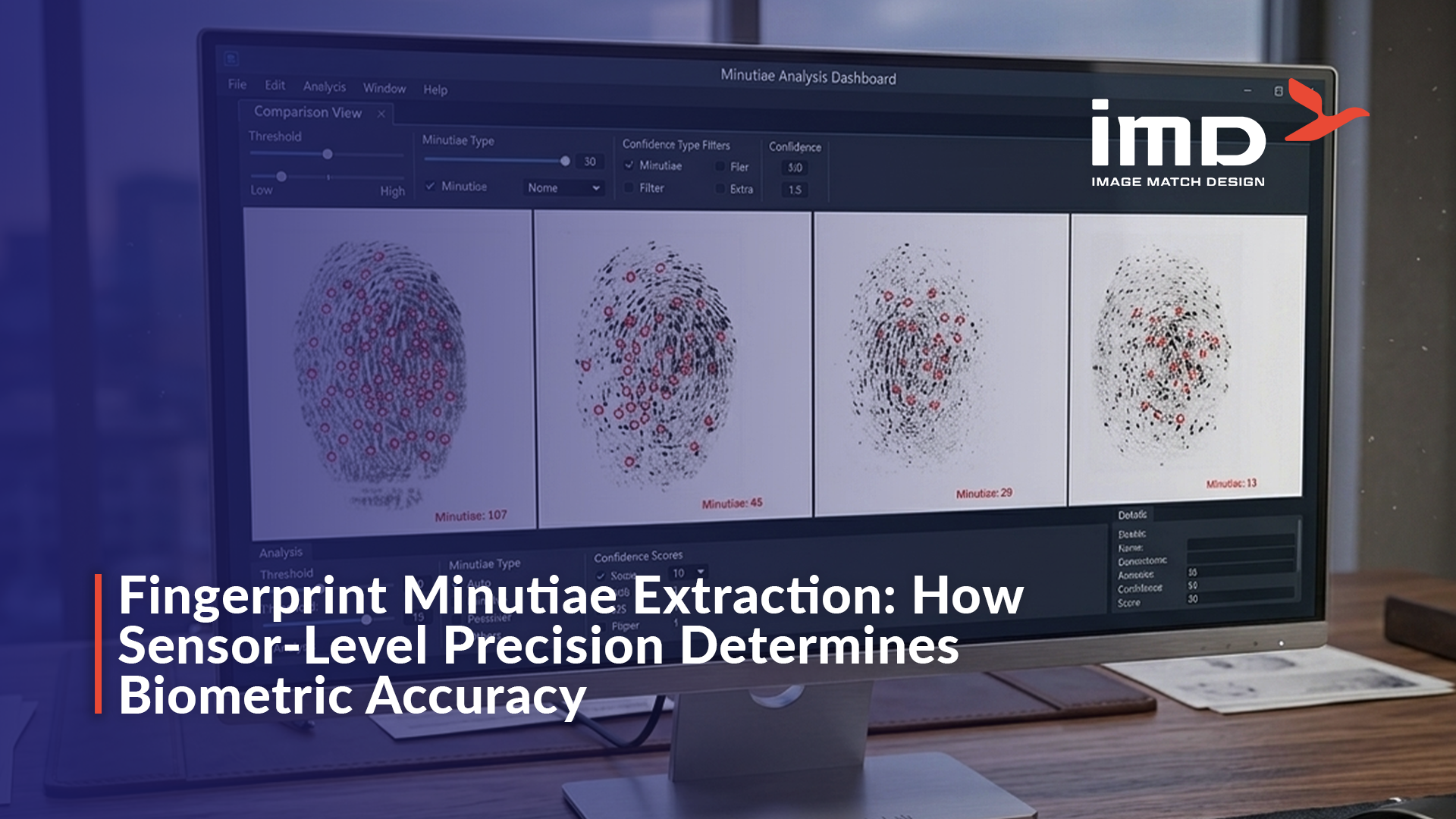
Fingerprint Minutiae Extraction: How Sensor-Level Precision Determines Biometric Accuracy
7 min read
Every fingerprint matching decision — whether at a national ID enrollment station, a banking KYC terminal, or an access control reader — traces back to a single technical process: minutiae extraction. Before any algorithm compares two fingerprints, before a match score is computed, before an identity is confirmed or rejected, the system must first identify and map the unique structural features of the ridge pattern captured by the sensor. That process is minutiae extraction, and its accuracy defines the ceiling for everything a biometric system can achieve.
Most discussions of biometric accuracy focus on matching algorithms or AI-driven verification engines. These matter — but they operate on the features extracted from sensor images. A matching algorithm cannot recover information that the sensor failed to capture. Fingerprint quality starts at the hardware level, and MatriXcan™ is engineered from the ground up to deliver the image quality that makes precise minutiae extraction possible across the full range of populations and deployment environments a real-world system encounters.
Primary Minutiae Types
Ridge endings, bifurcations — account for ~95% of features used in AFIS matching
Minutiae Per Finger
60–100 points on a typical adult finger; 12–20 matching points sufficient for a positive ID in most jurisdictions
Quality Standard
NFIQ 2.0 (NIST Fingerprint Image Quality) — scores 0–100; used as enrollment gate in national ID and law enforcement AFIS
Data Format Standard
ISO/IEC 19794-2 — defines minutiae template interchange format for interoperable biometric systems
Minimum Image Resolution
500 ppi for standard national ID and AFIS applications; 1000 ppi for latent forensic analysis
What Are Fingerprint Minutiae?
A fingerprint is a pattern of ridges and valleys on the fingertip surface, formed during fetal development and unique to every individual. At a macro level, these patterns fall into three broad types — loops, whorls, and arches — which provide a coarse classification useful for database partitioning. At the micro level, the ridges that form these patterns contain discontinuities: points where a ridge terminates, splits, or changes direction. These are minutiae — the fingerprint's structural fingerprints within the fingerprint.
The two minutiae types used in virtually all operational biometric systems are ridge endings — where a ridge line stops abruptly — and bifurcations — where a single ridge divides into two branches. Each minutia is characterized by three properties recorded in the biometric template: its (x, y) position within the image, its orientation angle relative to the ridge flow, and its type (ending or bifurcation). The resulting template is a sparse geometric map that captures the unique spatial relationships among these features — a map that no other finger on earth replicates.
Less commonly used minutiae types — dots (isolated ridge fragments), short ridges, and enclosures (ridge islands) — appear in some advanced matching systems and forensic AFIS platforms, but ridge endings and bifurcations remain the operationally dominant feature set due to their stability, extractability, and interoperability across vendor platforms.
The Extraction Pipeline: From Raw Sensor Image to Biometric Template
Minutiae extraction is a sequential image processing pipeline. Each stage transforms the sensor output one step closer to a structured template. The fidelity of each transformation depends on the quality of its input — and the quality of every input ultimately depends on the sensor that started the chain.
Stage 1 — Image Acquisition
The sensor captures a grayscale image of the fingertip in contact with or in proximity to the sensing surface. Resolution (ppi), contrast between ridges and valleys, noise level, and spatial uniformity across the capture area are the defining quality parameters at this stage. The image delivered to the extraction algorithm is entirely determined by sensor hardware — no downstream processing can add information that was not captured here.
Stage 2 — Image Enhancement
Enhancement algorithms — most commonly Gabor filter banks or short-time Fourier transform (STFT) analysis — sharpen ridge-valley contrast, suppress sensor noise, and normalize local intensity variations. Gabor filters are oriented at multiple angles to amplify ridges aligned with the local ridge flow direction while attenuating off-axis noise. This stage can partially compensate for mild image degradation, but cannot reconstruct ridge detail that was absent in the original capture.
Stage 3 — Ridge Detection and Skeletonization
The enhanced image is binarized — ridges become black pixels, valleys become white — and then skeletonized: each ridge is reduced to a single-pixel-wide centerline. This thinned ridge map is the direct input to the minutiae detection step. Skeletonization errors introduced by noise or low contrast in the source image cascade into false or missed minutiae downstream.
Stage 4 — Minutiae Detection and Post-Processing
The minutiae detector scans the thinned ridge map for structural patterns that correspond to endings (a ridge pixel with exactly one neighbor) and bifurcations (a ridge pixel with exactly three neighbors). Each detected point is assigned its (x, y) coordinates and orientation from the local ridge flow field. Post-processing removes false minutiae — spurious detections caused by ridge breaks, sensor artifacts, or skeletonization defects — using geometric consistency checks and local density filters. The result is the final minutiae template, formatted according to ISO/IEC 19794-2 for interoperable storage and matching.
Why the Sensor Is the Bottleneck — Not the Algorithm
There is a persistent assumption in biometric system design that better matching algorithms can compensate for mediocre sensor hardware. This assumption breaks down in practice. Matching algorithms compare templates derived from two fingerprint captures. If either template was extracted from a poor-quality image — with missing ridges, noise-induced false minutiae, or low-contrast captures — the match score becomes unreliable regardless of the algorithm's sophistication.
NIST's NFIQ 2.0 quality scoring algorithm quantifies this directly. NFIQ 2.0 computes a quality score (0–100) from the raw sensor image before any minutiae extraction occurs, using a set of 10 quality feature components including local clarity, ridge-valley contrast, orientation certainty, and minutiae count prediction. Studies consistently show a strong correlation between NFIQ 2.0 score and final matching accuracy: images scoring below 20–30 produce dramatically elevated False Non-Match Rates, while images scoring above 70 deliver near-optimal matching performance.
For deployment-scale systems — national ID enrollments of tens of millions, banking authentication terminals handling hundreds of transactions per day — the distribution of NFIQ 2.0 scores across a population determines aggregate system accuracy. A sensor that consistently delivers high NFIQ scores across diverse fingerprint conditions raises the floor for the entire system. A sensor with inconsistent capture quality — performing well on ideal fingers but degrading on elderly, dry, or worn fingertips — creates an accuracy gap that manifests as rejected enrollments and failed authentications at scale.
Cross-Population Challenges: Where Extraction Breaks Down
Laboratory evaluations of fingerprint sensors are typically conducted on demographically constrained test populations — volunteers from a narrow age range, skin tone distribution, and occupational profile. The resulting accuracy figures may not reflect real-world performance when the sensor is deployed at national scale across a population that includes elderly citizens with worn ridge detail, agricultural workers with cracked or callused fingertips, populations in high-humidity environments, and individuals with naturally low ridge contrast.
Age-Related Ridge Degradation
Fingerprint ridge detail flattens and loses contrast with age due to reduced skin elasticity and moisture. Optical sensors — which rely on the contrast between ridges in contact with the platen and valleys not in contact — are particularly sensitive to this effect. A sensor with insufficient dynamic range in its imaging system will produce low-contrast captures for elderly users, resulting in sparse minutiae templates and high false non-match rates.
Occupational Wear and Environmental Conditions
Manual labor, agricultural work, and chemical exposure physically abrade fingerprint ridges over time. Users with worn ridges have fewer extractable minutiae per capture, requiring sensors with higher sensitivity and resolution to resolve the remaining detail. Environmental factors — dry air reducing finger moisture, humidity causing excess sweat on the platen, outdoor temperature extremes — similarly degrade capture quality on sensors not designed for environmental resilience.
Skin Tone and Optical Contrast
Optical fingerprint sensors that image the fingertip surface using reflected or frustrated total internal reflection (FTIR) light can exhibit reduced ridge-valley contrast at certain skin tones. Sensors designed and validated for cross-population consistency maintain high image quality across the full skin tone spectrum — a requirement that is often underspecified in procurement documents but critical for programs serving diverse national populations.
How MatriXcan™ Redefines Minutiae Precision at the Sensor Level
MatriXcan™ sensors from iMD are designed around a single engineering priority: delivering fingerprint images of consistently high quality across the full population diversity and deployment environment range that real-world programs demand. This means the performance characteristics that matter for minutiae extraction — resolution, contrast, noise profile, and cross-population consistency — are not an afterthought in MatriXcan™ design. They are the design.
For OEM manufacturers building fingerprint terminals, kiosks, ATMs, and mobile enrollment devices, sensor selection at the design stage determines the accuracy profile of the finished product for its entire operational life. MatriXcan™ sensor modules provide the image quality foundation that enables downstream matching systems — whether deployed in a national AFIS, a banking KYC platform, or an enterprise access control system — to perform at their designed accuracy ceiling rather than being constrained by sensor-introduced noise and quality variability.
MatriXcan™ Precision Differentiators
High-Fidelity Ridge Imaging
MatriXcan™ sensors capture fingerprint images at resolutions meeting and exceeding FBI FAP certification thresholds, with consistent ridge-valley contrast across the full capture area. This enables extraction algorithms to reliably identify the maximum number of true minutiae per capture — producing dense, accurate templates that maximize matching confidence at every transaction.
Cross-Population Consistency
MatriXcan™ imaging is validated across diverse demographic profiles, including elderly users with reduced ridge depth, dry-skin populations, and users with occupational wear patterns. By maintaining high NFIQ-equivalent image quality across these groups, MatriXcan™ reduces the false rejection rate variability that plagues sensors optimized for a narrow test population — a critical property for national ID and financial inclusion programs.
Hardware-Level Liveness at the Capture Stage
MatriXcan™ presentation attack detection (PAD) operates at the sensor acquisition layer, not as a post-capture software analysis. This means liveness verification and minutiae-quality capture occur in the same physical process — a live fingertip that would produce a good-quality image is confirmed live before any matching occurs, without requiring separate hardware or additional processing latency.
Multi-FAP Module Range for Any Deployment Tier
MatriXcan™ sensor modules span FAP 20 through FAP 60 certification levels, enabling OEM product builders to select the capture profile appropriate for each deployment — from FAP 20 compact modules for portable field devices to FAP 60 ten-print slap sensors for high-assurance enrollment stations — while maintaining consistent image quality standards and extraction performance across the entire product family.
Frequently Asked Questions
+ What are minutiae in fingerprint biometrics?
Minutiae are the unique structural discontinuities in fingerprint ridge patterns used as reference points for identity matching. The two primary types are ridge endings — where a ridge terminates — and bifurcations — where a ridge splits into two. A typical adult finger carries 60 to 100 minutiae. Each point is characterized by its position, orientation, and type, forming a template that is statistically unique to every individual.
+ How does fingerprint minutiae extraction work?
Extraction is a pipeline: the sensor captures a raw image → Gabor or STFT enhancement sharpens ridge contrast → binarization and skeletonization reduce ridges to single-pixel centerlines → a minutiae detector identifies endings and bifurcations → post-processing removes false detections → the final template is assembled in ISO/IEC 19794-2 format. Each stage depends on the quality of the preceding one — and image quality is set entirely by the sensor at the first stage.
+ What is NFIQ and why does it matter?
NFIQ 2.0 (NIST Fingerprint Image Quality) is a standardized algorithm that scores each captured fingerprint image from 0 to 100 before extraction occurs. Higher scores correlate strongly with accurate minutiae extraction and reliable matching. National ID programs, AFIS systems, and enterprise platforms use NFIQ thresholds as enrollment gates — images below the threshold trigger a re-scan rather than producing a low-quality template that degrades the database.
+ What affects fingerprint minutiae extraction accuracy?
Sensor resolution and contrast quality are the primary determinants. Environmental factors — dry, wet, dirty, or worn fingers — degrade the input image and reduce extractable minutiae count. Population factors including age (ridge flattening in elderly users), occupation (mechanical wear), and skin tone (contrast effects on optical sensors) introduce additional variability. Post-processing can remove some noise, but cannot reconstruct ridge detail that the sensor never resolved.
+ How does sensor quality affect biometric matching accuracy?
Sensor quality determines the information ceiling for all downstream processing. A low-quality image produces sparse templates with unreliable minutiae positions and orientations, which raises both False Match Rate and False Non-Match Rate regardless of the matching algorithm used. A sensor that consistently delivers high-quality images — even under adverse conditions — produces dense, accurate templates that enable the matching engine to operate at its designed accuracy ceiling.
Precision Is Not a Software Problem
The sophistication of a biometric matching algorithm is only as valuable as the quality of the templates it compares. Templates are only as accurate as the minutiae extraction process that produced them. And minutiae extraction is only as reliable as the sensor image it starts from. In this chain, the sensor is not the last consideration — it is the first and most consequential one.
For systems integrators, OEM hardware manufacturers, and procurement teams specifying fingerprint biometric infrastructure, sensor selection should be evaluated on the same technical rigor applied to matching algorithm benchmarking: NFIQ score distributions across diverse populations, False Rejection Rate by demographic segment, image quality consistency under environmental stress, and certification evidence from independent testing. These are the specifications that determine whether a biometric deployment performs as designed — at the enrollment station, at the authentication terminal, and across the full operational life of the program.
iMD designs MatriXcan™ fingerprint sensor modules to meet this standard — delivering the image fidelity, cross-population consistency, and certified performance that precision minutiae extraction demands, in every deployment context from portable field enrollment kits to high-throughput national ID enrollment centers.
See MatriXcan™ Precision in Your Deployment Context
Talk to iMD's engineering team about MatriXcan™ sensor specifications, image quality performance data, and integration support for your biometric hardware application.
Request MatriXcan™ Technical Specifications →
fingerprint minutiae extraction
biometric matching accuracy
NFIQ fingerprint image quality
ridge ending bifurcation fingerprint
fingerprint feature extraction
sensor-level biometric precision
ISO 19794-2 minutiae template
fingerprint false non-match rate
cross-population fingerprint accuracy
MatriXcan fingerprint sensor
fingerprint image enhancement Gabor
FAP certification fingerprint sensor