

iMD Market Intelligence | May 2026 | Law Enforcement & Government
AFIS Market Growth to 2028: Why Law Enforcement Is Modernizing Fingerprint Systems Now
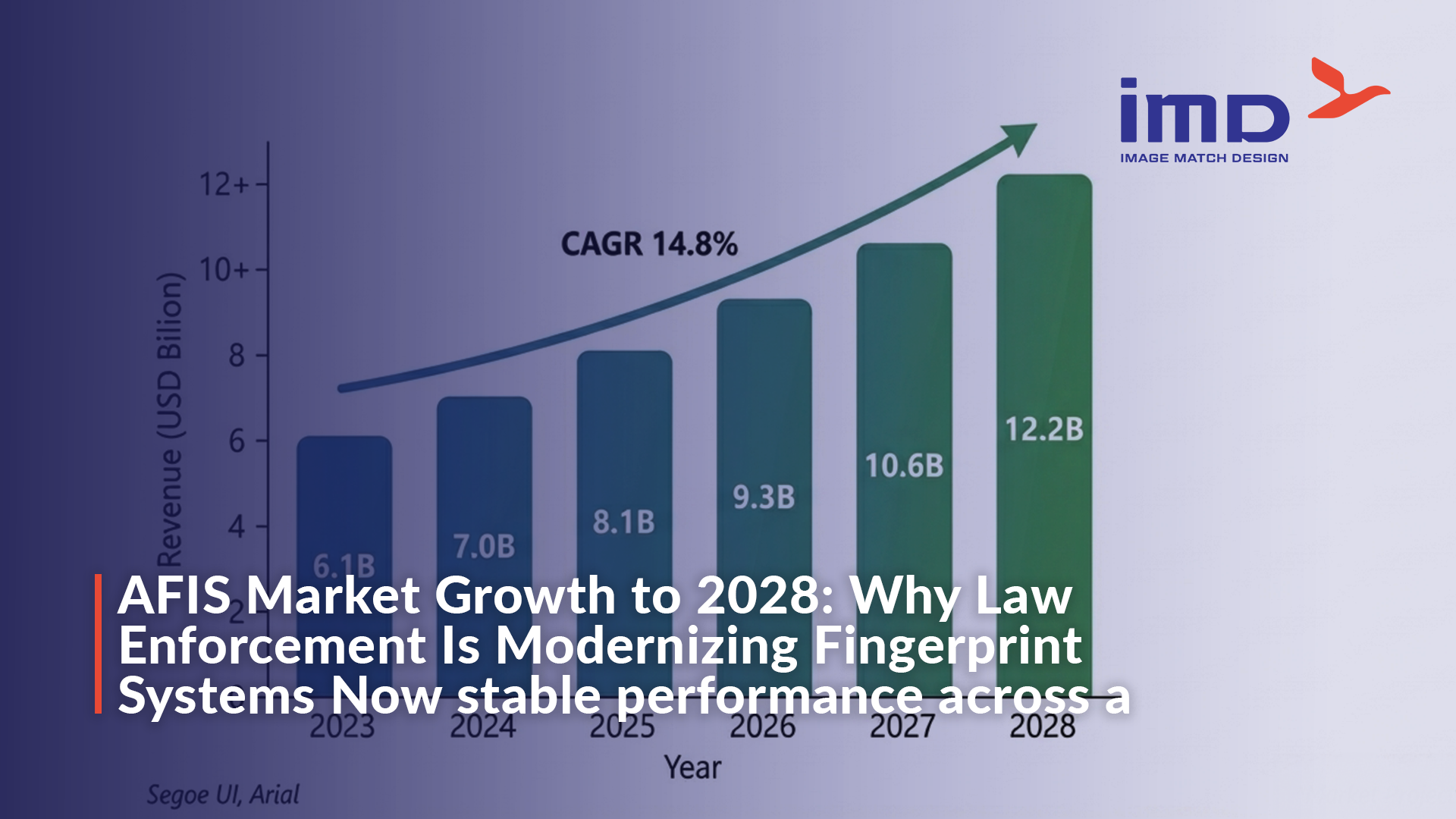
The global market for Automated Fingerprint Identification Systems is expanding at a pace that reflects both the scale of investment flowing into law enforcement biometrics and the urgency of the modernization challenge facing agencies worldwide. Valued at approximately USD 5.32 billion in 2022, the AFIS market is forecast to reach USD 15.42 billion by 2028 — a trajectory driven by criminal justice digitization, cross-agency database integration mandates, and the growing performance gap between legacy platforms and current algorithmic capabilities.
For procurement officers, IT directors, and system integrators working within law enforcement and government identity programs, understanding this market shift requires more than tracking growth figures. It requires clarity on what is driving modernization decisions, where legacy systems are falling short, and what capabilities define a current-generation AFIS deployment. This article addresses each of these dimensions to support informed procurement and technology planning.
2022 Market Value:
USD 5.32 billion (global)
2028 Forecast:
USD 15.42 billion
Projected CAGR:
~17.75% (2025–2032 projection)
Largest Segment:
Law Enforcement (criminal records, forensics, background checks)
US Investment Signal:
CJIS budget increased from $633M (FY2025) to ~$800M (FY2026)
What Is Driving AFIS Market Growth?
The expansion of the AFIS market reflects several reinforcing trends operating simultaneously across government and law enforcement sectors globally.
Digital forensics investment. Law enforcement agencies at all levels — municipal, state, federal, and international — have accelerated investment in digital forensic capabilities, with fingerprint biometrics remaining the most admissible and court-tested identification evidence in criminal proceedings. AFIS platforms are foundational infrastructure for this capability, and agencies that operated decade-old systems are now facing pressure to upgrade both matching accuracy and database scale.
Border control and national identity programs. Beyond criminal justice, AFIS infrastructure underpins border entry biometrics, visa processing, and national ID enrollment — all of which have expanded significantly as governments deploy or scale sovereign identity systems. The intersection of criminal, civil, and immigration fingerprint databases has created demand for platforms capable of operating across these use cases within a unified architecture.
AI and algorithm improvements creating a performance gap. Modern matching algorithms — many of which incorporate machine learning for latent print enhancement and partial print matching — have substantially outperformed the algorithmic generation deployed in legacy AFIS platforms from the 2000s and 2010s. Agencies that remain on older platforms are increasingly aware of the identification accuracy gap, particularly in cold case and latent print work where improved algorithms translate directly into investigative outcomes.
The Modernization Imperative: Where Legacy AFIS Systems Are Falling Short
The scale of the legacy system problem in law enforcement biometrics is substantial. In the United States alone, an estimated 600 disparate AFIS systems operate at state, local, and federal levels — the majority of which are not interoperable from either a technical or governance standpoint. An examiner in one jurisdiction typically cannot search a neighboring agency's fingerprint database without manual coordination, creating delays and investigative blind spots in cases that cross jurisdictional lines.
The FBI's own modernization trajectory illustrates both the complexity and the investment required. The transition from IAFIS — the agency's national fingerprint database introduced in 1999 — to the Next Generation Identification (NGI) system involved years of phased development across multiple system increments. In a further signal of ongoing modernization commitment, the FBI awarded a $128 million task order to support continued NGI agile development, algorithm advancement, and mobile application capabilities. This investment reflects a recognition that biometric identification infrastructure is not a static technology purchase but a continuously evolving operational platform.
For agencies outside the federal level, the challenge is compounded by budget constraints, proprietary vendor lock-in on legacy systems, and the complexity of migrating large historical fingerprint databases — some containing records accumulated over decades — to modern platforms without losing data integrity or operational continuity.
Key Technology Shifts Reshaping AFIS Deployments
Three technology shifts are materially changing what agencies should expect from a modern AFIS platform and its supporting hardware.
AI-Assisted Latent Print Matching
Machine learning models have significantly improved the ability of AFIS platforms to process and match low-quality, partial, or distorted latent prints recovered from crime scenes. Algorithms trained on large, diverse fingerprint datasets can enhance ridge detail, compensate for partial contact, and produce candidate lists with greater accuracy than previous generation rule-based matchers. NIST released updated latent fingerprint quality assessment software in early 2026, reflecting the research community's ongoing investment in improving the input quality pipeline. Improved latent matching directly expands the pool of previously unsolvable cases that become actionable with a current-generation platform.
Cloud-Ready and Open-Architecture Platforms
Legacy AFIS platforms were typically built as proprietary, on-premise systems with closed APIs and vendor-specific data formats that inhibited interoperability. Modern platforms increasingly adopt open architecture principles — standardized APIs, vendor-agnostic data formats, and cloud-compatible deployment models — that enable agencies to integrate AFIS with broader identity management infrastructure, share data across jurisdictions, and upgrade matching algorithms without wholesale platform replacement. Cloud integration has enabled real-time data analysis across jurisdictions, creating a more interconnected law enforcement identity infrastructure while maintaining required data governance controls.
Mobile and Edge Capture Hardware
The expanding use of mobile fingerprint terminals in field policing, border patrol, and disaster response has increased demand for ruggedized, high-quality fingerprint sensors that can perform reliably outside controlled booking environments. AFIS databases are only as accurate as the images submitted to them — and mobile capture hardware must deliver consistent image quality across diverse skin conditions, environmental variables, and operator skill levels. This has placed greater emphasis on sensor-level intelligence, including image quality feedback, presentation attack detection, and adaptive capture algorithms that guide operators toward acceptable image quality in real time.
Procurement Considerations: What Law Enforcement Agencies Should Evaluate
Agencies planning AFIS modernization programs — whether at the platform, database, or capture hardware level — face procurement decisions with long operational and financial consequences. The following considerations provide a structured basis for evaluation.
Interoperability standards compliance. Require adherence to established biometric data exchange standards — including ANSI/NIST-ITL for fingerprint image formatting and transmission — to ensure that new systems can exchange data with federal platforms (NGI, DHS IDENT) and neighboring jurisdictions without manual re-encoding.
Algorithm transparency and third-party benchmarking. Request NIST FPVTE (Fingerprint Vendor Technology Evaluation) participation data for any matching algorithm under consideration. Independent benchmarking provides a comparable performance baseline that vendor-supplied accuracy figures cannot. For latent print matching specifically, evaluate performance on low-quality and partial print datasets rather than only rolled or flat ten-print samples.
Sensor hardware quality at scale. The quality of fingerprint images entered into the AFIS database determines the ceiling of achievable matching accuracy for the system's operational lifetime. Agencies should specify capture hardware with documented image quality performance across the full range of population characteristics expected in their jurisdiction — including dry, scarred, aged, and worn fingerprints — and require sensors that provide real-time image quality feedback to operators. For agencies deploying fingerprint capture at mobile or field points, sensor resilience under environmental conditions is equally important.
iMD's MatriXcan™ fingerprint sensing technology is designed specifically for deployment scenarios where consistent capture quality across diverse populations and environments is a requirement rather than an assumption. For agencies evaluating fingerprint capture hardware as part of an AFIS modernization program, MatriXcan™ provides sensor-level intelligence that supports both image quality assurance and presentation attack detection — capabilities that directly affect the long-term accuracy and integrity of the AFIS database.
Frequently Asked Questions
+ What is an AFIS system and how is it used by law enforcement?
An Automated Fingerprint Identification System (AFIS) is a large-scale database and algorithmic matching platform that stores digitized fingerprint records and enables rapid automated searching and comparison. Law enforcement agencies use AFIS to match crime-scene latent prints against criminal record databases, verify identities during booking, support cross-agency background checks, and connect fingerprint evidence to known individuals across jurisdictional lines. Modern platforms can search databases of hundreds of millions to over a billion records in under a second.
+ How large is the AFIS market and what is its projected growth rate?
The global AFIS market was valued at approximately USD 5.32 billion in 2022 and is forecast to reach USD 15.42 billion by 2028. Projections extending to 2032 place the market at USD 44.76 billion, growing at a CAGR of approximately 17.75%. Law enforcement remains the largest application segment, reflecting continued investment in criminal database modernization, digital forensics, and cross-jurisdictional biometric infrastructure.
+ Why are law enforcement agencies modernizing their AFIS systems now?
Several converging pressures are driving modernization: legacy platforms lack the algorithmic accuracy required for current-standard latent print matching; fragmented local and federal databases create interoperability gaps; cloud-ready architectures now enable scalable, real-time data sharing across jurisdictions; and AI/ML improvements in partial and latent print matching have created a meaningful performance gap between current-generation and aging systems. Increased budget allocations — the US CJIS budget rose from $633M in FY2025 to approximately $800M in FY2026 — have also expanded the procurement capacity available for upgrade programs.
+ What is the difference between AFIS, IAFIS, and NGI?
AFIS is the generic term for any Automated Fingerprint Identification System. IAFIS was the FBI's national fingerprint database, introduced in 1999, focused primarily on fingerprints and criminal history records. NGI (Next Generation Identification) is the FBI's successor to IAFIS, expanded to include palm prints, iris, face, and voice biometrics alongside fingerprints, with improved latent print matching, mobile access, and photo capability. The FBI has continued investing in NGI modernization, including a $128 million task order for agile development and algorithm advancement.
+ What are the biggest challenges in AFIS modernization for government agencies?
The primary challenges include: interoperability between approximately 600 disparate AFIS systems at state, local, and federal levels in the United States — most lacking standardized data formats or shared protocols; migration of large historical databases from proprietary legacy platforms without losing data integrity or operational continuity; procurement cycle timelines that lag behind technology evolution; training and workflow change management for forensic examiners; and increasingly complex cybersecurity requirements as database scale and sensitivity have grown.
+ How does fingerprint sensor quality affect AFIS matching accuracy?
Sensor quality determines the quality of every fingerprint image entered into the AFIS database — and database image quality is the most significant upstream variable affecting long-term matching accuracy. Low-quality capture hardware creates records with insufficient ridge resolution, distortion, or noise that are difficult to match against future queries. Sensors deployed at high-volume points — booking stations, border checkpoints, field kiosks — must consistently capture high-quality images across diverse populations and environments. Sensor capabilities including resolution, anti-spoofing, real-time image quality feedback, and resilience to dry or worn fingers directly determine downstream identification rates throughout the system's operational lifespan.
Conclusion: Planning for the Next Generation of Law Enforcement Biometrics
The AFIS market growth trajectory through 2028 and beyond reflects a fundamental shift in how law enforcement and government agencies are approaching fingerprint biometric infrastructure — moving from isolated, proprietary legacy deployments toward integrated, algorithm-forward platforms designed for interoperability, scale, and continuous improvement.
For agencies navigating modernization decisions, the key variables are not merely platform selection and database migration — they extend to the quality and capability of every fingerprint capture point in the system. A modern AFIS platform is only as accurate as the images submitted to it, which places fingerprint sensor hardware at the center of any serious modernization program.
iMD designs the MatriXcan™ fingerprint sensing platform to meet the demanding capture requirements of government identity programs and law enforcement deployments — where cross-population accuracy, environmental resilience, and sensor-level integrity are operational necessities. Organizations planning AFIS modernization programs are encouraged to contact iMD to discuss how MatriXcan™ can support their fingerprint capture infrastructure requirements.
Request an AFIS Modernization Consultation
Speak with the iMD team about fingerprint capture hardware requirements for your AFIS modernization program. Learn how MatriXcan™ supports law enforcement and government biometric deployments at scale.
Contact iMD →
AFIS market growth
automated fingerprint identification system
law enforcement biometrics
fingerprint modernization
AFIS interoperability
NGI modernization
latent print identification
biometric fingerprint database
AFIS cloud migration
fingerprint scanner law enforcement
MatriXcan fingerprint sensor
government biometric procurement